

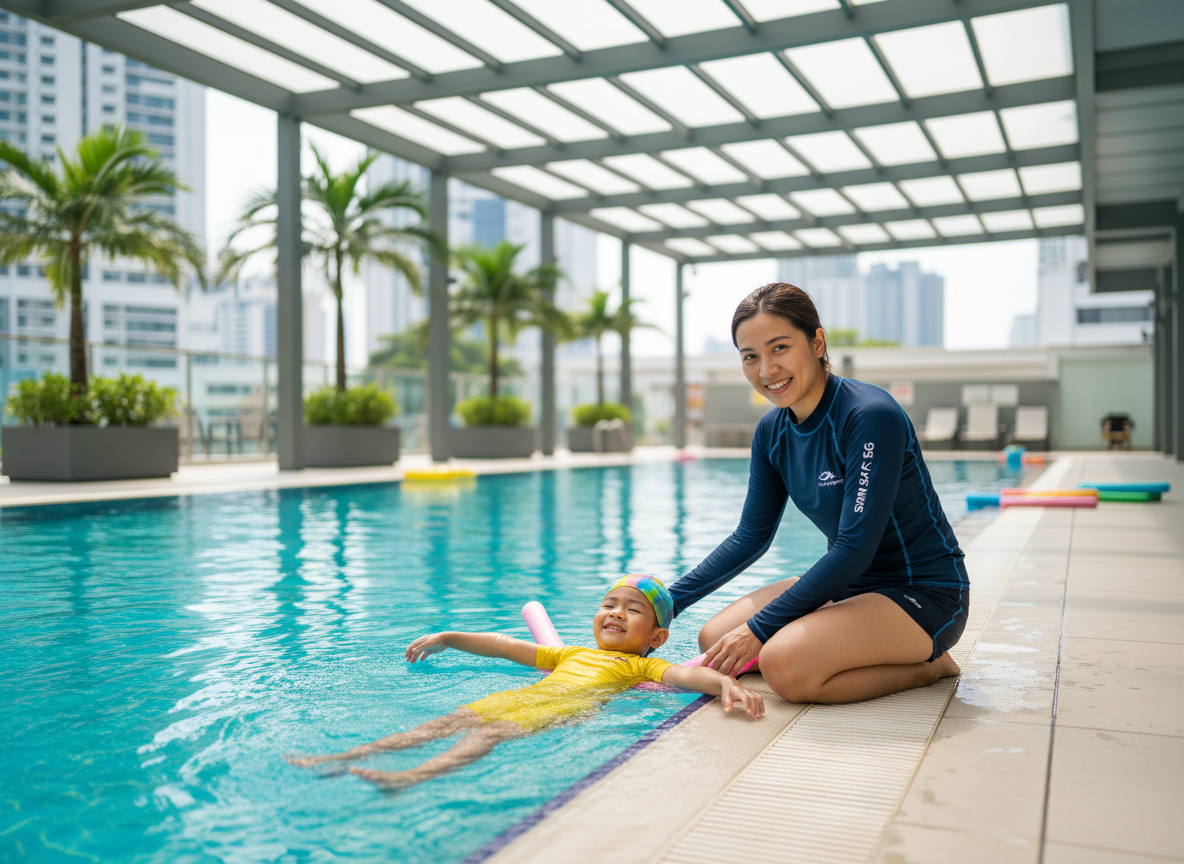
A condominium pool can be a convenient place to learn swimming in Singapore, subject to management rules, pool suitability and coach access. It is close to home, familiar to children and usually quieter than a public complex. But it is still a shared facility. A productive lesson should never come at the expense of neighbours who want to swim laps, relax or supervise their own children. Good condo pool etiquette keeps lessons safe, calm and welcome.
The practical rules are simple: follow the by-laws, share space, control equipment and communicate early.
Why condo pool etiquette matters
A condo pool is not a private classroom, even when you have booked a condo swimming lesson at home. Residents have equal rights to the facility, and the management council may set conditions on outside coaches, teaching hours, group size or commercial activity. Ignoring those rules can lead to complaints or a coach being refused entry.
Etiquette also affects safety. A kickboard drifting across a lane, a child running to collect a toy or a group blocking the steps creates a preventable hazard. Clear boundaries let the coach concentrate on teaching instead of managing conflicts. Families comparing programmes can browse structured swimming classes in Singapore and lesson options around Singapore, but the same shared-space principles apply wherever the class takes place.
Check the condo rules before the first lesson
Ask the management office, not the security guard on arrival
Before confirming a lesson, check the current by-laws with the management office. Ask whether external instructors must register, whether insurance is required and whether teaching hours are restricted. Some estates allow one-to-one instruction but not larger commercial groups.
Give the coach entry and parking details before the session. If you are still choosing an instructor, a directory for finding an experienced swimming coach can help, while information about swimming instructor training explains professional preparation.
Look at the pool layout and busy periods
Visit the pool at the proposed lesson time. A weekday afternoon may be peaceful during term time but crowded during school holidays. Note the depth changes, steps, ladders, spa jets, blind corners and any lap markings. The nearest convenient pool is not automatically the most suitable; resources for finding swimming options nearby and checking Singapore swimming complex facilities can provide alternatives when the condo pool is too small or busy.
Choose the right place in the pool
The best teaching area depends on the learner. Beginners need a depth where they can stand comfortably, while stroke correction needs a clear straight path. The coach should arrive a few minutes early, observe how residents are using the pool and select a space that causes the least disruption.
- Keep steps and ladders clear for entry and emergencies.
- Do not teach directly across an established lap-swimming line.
- Use one side of a wide pool rather than occupying the centre.
- Avoid spa areas, water features and blind corners.
- Move the lesson if the chosen area becomes crowded with young children.
When a resident is already swimming lengths, ask which side they prefer rather than placing equipment in their path. A short, friendly conversation usually prevents irritation. Coaches who regularly teach in residential settings, including specialists listed for condo swimming across Singapore, should be comfortable adapting drills to unusual pool shapes.
Manage equipment without taking over the deck
A private lesson rarely needs a bag full of gear. One kickboard, a few compact toys and perhaps a noodle are usually enough. Lay equipment together at the pool edge where it cannot roll into a walkway. Count small toys before and after the session, and never leave floats drifting while the coach attends to something else.
Parents should keep prams, shoes, bags and food away from the wet deck. Glass containers should never be brought into the pool area. Goggles and swim caps should be fitted before the lesson begins so the coach does not spend ten minutes adjusting equipment. Established providers such as Swim2u swimming lessons and Swim Schools International programmes can offer useful points of comparison when families assess lesson structure and equipment needs.
Respect noise, privacy and other residents
Keep instructions calm and purposeful
A coach must be heard, but constant shouting across the pool is unnecessary. Teach from close range and use short cues. Games can be lively without involving screaming, whistles or music. In a residential estate, sound travels upward between blocks, so early-morning and evening lessons deserve extra care.
Do not photograph other pool users
Video can help with stroke correction, but obtain the learner’s or parent’s permission and frame the shot tightly. Stop recording when other residents enter the background. Never post footage that identifies residents, unit numbers or children who are not part of the lesson. Privacy is part of good condo pool etiquette, not an optional courtesy.
Make inclusive lessons feel ordinary
Some learners need more repetition, visual cues, reduced noise or a predictable section of the pool. Families considering special-needs swimming lessons should tell the coach about sensory and communication needs in advance. Coaches can also learn from Singapore-focused special-needs resources for families. Adaptation should support the swimmer without demanding that every other resident leave the facility.
What parents should do during a child’s lesson
A parent should remain attentive nearby when the child is young or condo rules require it. The coach teaches; the parent still supervises siblings and helps with toilet breaks or emotional regulation.
- Arrive early enough for changing and a toilet visit.
- Tell the coach about illness, fatigue, medication or a recent scare in the water.
- Keep siblings beside you; do not let them join the lesson informally.
- Avoid correcting the child from the deck while the coach is speaking.
- Leave promptly after the lesson if another booking is waiting.
For age-appropriate expectations, see the guides to swimming lessons for children and toddler swimming lessons. A good lesson feels focused, not rushed, because the routine around it is already organised.
Safety rules that etiquette cannot replace
Courtesy matters, but it does not replace active supervision or sound teaching. A learner should never enter the water before the coach is ready. Children must walk on the deck, and nobody should dive unless the depth and condo rules clearly permit it. If thunder is heard or lightning procedures are activated, leave the water immediately and follow the facility’s instructions.
Sport Singapore’s public guidance consistently treats swimming competence and water safety as skills developed through structured practice. That is a useful standard for condo lessons: progress should include safe entry and exit, breath control, floating, recovery and an understanding of personal limits—not just completing a stroke.
How to handle common conflicts politely
Most issues can be solved in under a minute when nobody becomes defensive. Use this simple sequence:
- Pause the activity. Remove the immediate obstruction or noise.
- Acknowledge the concern. Let the resident explain without interrupting.
- Offer a specific adjustment. Move to one side, shorten the drill or collect the equipment.
- Check the written rule later. Do not argue about by-laws from memory beside the pool.
If a dispute returns, ask management to clarify the approved arrangement in writing. Do not move the argument into a condo chat group.
A practical pre-lesson checklist
- Coach registration and visitor access confirmed
- Approved lesson time checked
- Weather and lightning risk reviewed
- Swimwear, towel, goggles and water bottle packed
- Only essential teaching equipment brought
- Lesson zone chosen without blocking access
- Parent supervision plan agreed
- All equipment and rubbish removed afterward
PrivateSwimming.sg offers private, condo, kids, adult, ladies-only and additional-needs lessons, subject to coach availability and venue access. Ask us to confirm the proposed coach’s current credentials and relevant experience. Adults who prefer a tailored pace can review private adult swimming lessons, while women seeking a more comfortable arrangement can explore ladies-only swimming lessons. The broader PrivateSwimming.sg lesson overview explains the available formats.
PrivateSwimming.sg is part of a wider sister network that also includes home tuition support, air-conditioning services and digital marketing services.
Frequently asked questions
Are private swimming coaches allowed at every condo pool?
No. Rules vary by estate. Some permit registered one-to-one coaching, while others restrict commercial instruction or require prior approval. The resident should confirm the current by-laws before booking.
Who should register the coach with management?
The resident usually starts the process because they can access the management office and resident portal. The coach should provide requested identification, certification or insurance information promptly.
How much pool space should one lesson use?
Use the smallest area that safely supports the skill being taught. Beginners may need one quiet corner; stroke work may need a straight length. Neither arrangement should block steps, ladders or the whole pool.
Can two or three children share a condo lesson?
Only if condo rules allow it and the children have compatible ages and abilities. A small group can be efficient, but it needs more space and closer behaviour management than a one-to-one lesson.
What if a lap swimmer enters during the lesson?
Acknowledge them and agree on a clear side or line of travel. Move equipment immediately. If the pool is too narrow to share safely, adapt to stationary skills or relocate the lesson.
Should lessons continue during light rain?
Rain alone may not require closure, but lightning risk does. Follow the condo’s warning system and instructions without debate. Never remain in the water to “finish one last drill”.
Can a coach film a child for stroke analysis?
Yes, with parent or learner consent and careful framing. Avoid capturing other residents, and agree on how the clip will be stored, shared and deleted.
What should we do if a resident complains?
Pause, listen and make a reasonable immediate adjustment. Then verify the written condo rule with management. A calm response protects the lesson arrangement far better than arguing poolside.
Conclusion
Good condo pool etiquette is mainly thoughtful preparation made visible: permission checked, space shared, equipment controlled, noise moderated and safety rules followed. When parents and coaches handle those details before the learner enters the water, a residential pool can support focused teaching without ceasing to be a shared home facility.
If you have confirmed your condo’s instructor and pool-use rules, enquire about a private swimming lesson and include the location, learner’s current level and preferred timing.
🏊 From the Pool Deck — Our Coaching Experience
Having guided over 5,000 swimmers across Singapore since 2015 — from adults who feared the water to children aiming for SwimSafer Gold — every tip and recommendation in this article comes directly from our coaches’ real-world experience at poolside. We coach weekly at condominiums, public pools, and private facilities islandwide, and we update our content to reflect what we actually see working for Singapore swimmers today.
📚 Official Sources & Further Reading
About This Article
Written by the PrivateSwimming.sg coaching team — AUSTSWIM-certified instructors and Singapore Lifesaving Society (SLSS) members who have personally coached over 5,000 swimmers across Singapore since 2015, from anxious beginners to competitive teenagers preparing for SwimSafer Gold. Our coaches hold current First Aid and CPR certifications and operate under Singapore’s Child Protection (Vulnerable Persons) framework. Our swim curriculum is aligned with Sport Singapore’s SwimSafer 2.0 programme, the Singapore Swimming Association (SSA) coaching standards, and the Health Promotion Board (HPB) active living guidelines.
✔ AUSTSWIM Certified | ✔ SLSS Qualified | ✔ SwimSafer 2.0 Educators | ✔ 5,000+ Swimmers Coached Since 2015 | ✔ Sport Singapore Aligned | ✔ SSA Coaching Standards | Last reviewed: September 2026
Leave a Comment