

If your child cries at the edge of the pool, refuses to put their face in the water, or grips your arm the moment they feel the water rising past their waist, you are not alone. Fear of water in children is very common in Singapore, and it has nothing to do with how brave your child is. It is a natural, protective instinct — and with the right approach, it can be gently worked through.
Understanding Why Children Fear Water
Water is an unfamiliar environment. Unlike solid ground, it pushes back, moves, and does not behave like anything a child encounters on land. For young children, this unpredictability can feel threatening.
The Most Common Triggers
- A previous negative experience — swallowing water, slipping, or being splashed suddenly
- Being forced into the pool before they were ready
- Sensitivity to sensory input, such as water on the face or ears
- Seeing another child or adult in distress in the water
- Simply being small in a large, echoing, unfamiliar space
Understanding what triggered the fear matters, because it shapes how you help your child move past it. A child who was pushed into a pool needs different reassurance than a child who dislikes the sensation of water on their face.
When It Is More Than Shyness
For most children, water fear responds well to patient, graduated exposure. However, some children — particularly those with sensory processing differences, anxiety disorders, or autism spectrum conditions — experience water fear more intensely. For children with additional needs, specialist coaching is available through PrivateSwimming.sg’s special needs programme, and further resources can be found at specialneeds.com.sg.
Common Mistakes to Avoid
Before we get to what works, it is worth naming what tends to backfire. Forcing a screaming child into the pool almost always deepens the fear — it confirms that water is dangerous and that they have no control. Dismissing the fear with “there’s nothing to be scared of” invalidates a real signal and adds shame. Comparing your child to others creates pressure without building confidence. And switching coaches or pools too frequently resets the trust-building process every time.
A Step-by-Step Approach for Building Water Confidence
Singapore’s warm weather means pools are accessible all year round — genuinely good news for gradual exposure.
Step 1: Start Outside the Pool
Before asking your child to enter the water, spend time near it. Sit at the pool deck, watch other children swim, and let your child set the pace. For toddlers, bath time is a useful starting point — letting them pour water with a cup builds positive sensory associations before any formal lessons begin. If your toddler is curious but not yet ready for group classes, private toddler swimming lessons in a quieter setting can make the transition much easier.
Step 2: Enter on Their Terms
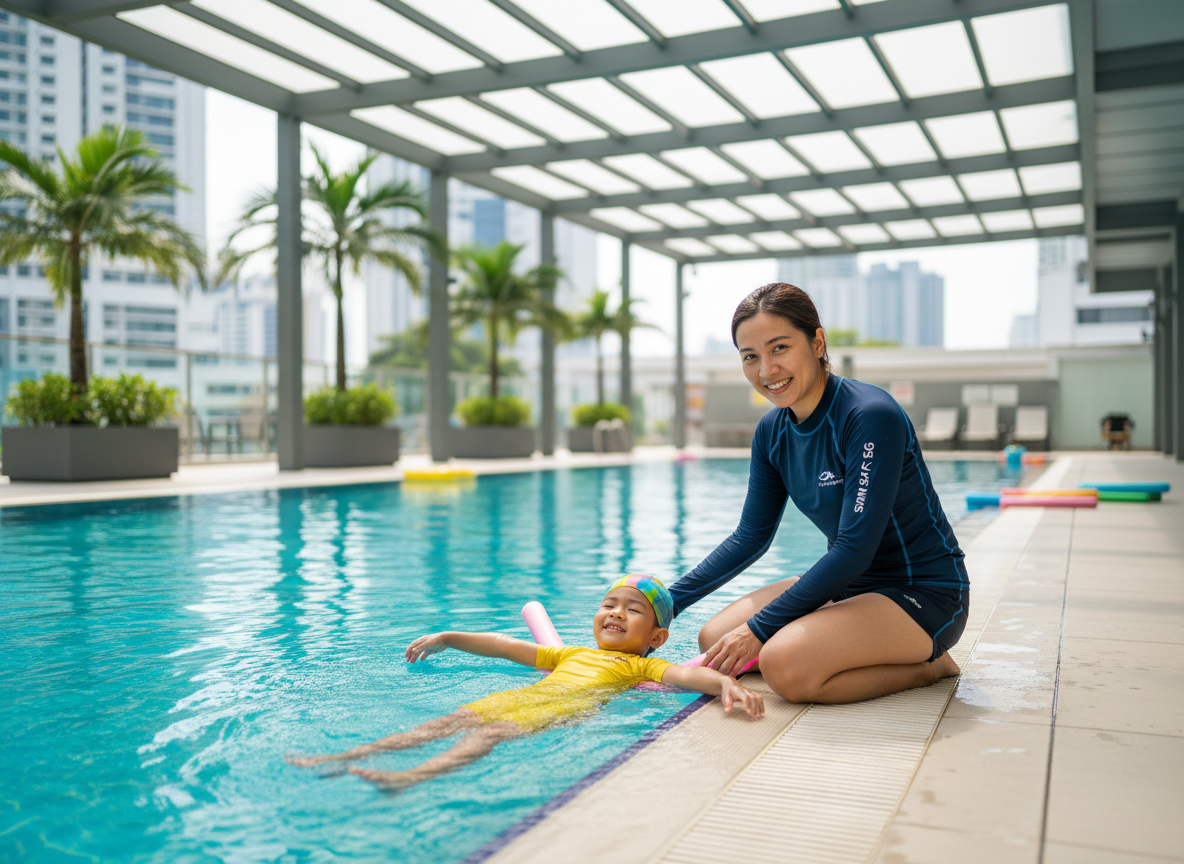
When your child is ready to enter the pool, do it together. Sit on the steps. Let the water come to them. A calm condo pool during off-peak hours is a better starting environment than a busy public swimming complex. If you have access to a condo facility, condo swimming lessons offer exactly this kind of quiet, controlled environment.
Step 3: Make the Face-in-Water Moment Gentle
For most water-anxious children, putting their face in the water is the moment of highest fear. Work through this gradually:
- Start with blowing bubbles with the mouth on the surface
- Progress to blowing bubbles with the nose
- Try holding a toy under the water while the face briefly follows it
- Celebrate every tiny step, even when it looks small from the outside
Many children who hated water immersion at age four are completely comfortable at age six. The brain needs enough positive experiences to outweigh the negative ones.
Step 4: Introduce a One-on-One Swim Coach
Group lessons work well for confident children, but for a water-anxious child, a one-on-one private swimming coach changes everything. A skilled private coach can move entirely at the child’s pace, build a trusting relationship over several sessions, adapt activities in real time, and give the child real agency during the session.
At PrivateSwimming.sg, certified coaches work with children of all temperaments across Singapore. Lessons can take place at your condo pool or a public pool near your home. Explore swimming lessons for kids or get in touch directly to discuss your child’s situation.
The Role of the Parent During Lessons
Your reactions matter more than you might think. Stay calm near the water — children read parents’ body language before they read the situation. Avoid coaching from the sideline; let the swim coach lead. Celebrate process rather than outcomes: “I saw you blow bubbles today” lands far better than “why can’t you just put your head under?” For some children, a parent stepping back from the pool deck entirely produces a noticeably calmer lesson.
Finding the Right Coach for a Nervous Child
Not every coach has experience with anxious children. When searching, ask: Have you worked with children who were afraid of water? How do you handle a child who refuses to enter the pool? Can I observe the first session?
Platforms that can help you find qualified instructors include swimmingcoach.sg, singaporeswimminglessons.sg, swimmingclasses.sg, swimmingnearme.sg, and swim2u.sg. For context on what coach certification involves, see swimminginstructorcourse.sg and for international swim education perspectives, swimschoolsinternational.sg. For pool venues across Singapore, swimmingcomplex.sg is a useful reference.
Realistic Timelines
How long will it take? It depends on age, temperament, and the nature of the fear, but here are general patterns:
- One bad experience: Often resolved within 4–8 sessions with a calm, consistent coach
- Generalised anxiety about new experiences: May take 10–20 sessions to reach comfortable, independent swimming
- Sensory sensitivities: Progress may be slower and non-linear, but it is achievable with the right specialist approach
The most important thing is that your child is moving in the right direction — not that they are moving at a particular speed.
FAQ: Helping a Child Overcome Fear of Water in Singapore
My child was fine in the pool last year. Why are they suddenly scared?
Fear can emerge or re-emerge at any age, often after a developmental leap or a new awareness of risk. It is not regression — it is a cognitive shift. Address it patiently with positive re-exposure.
Should I choose group lessons or private lessons for a scared child?
For a significantly water-anxious child, private one-on-one lessons are almost always more effective initially. A group lesson moves at the group’s pace, which may not match your child’s emotional readiness.
Is it okay to skip lessons if my child is very upset?
Occasionally, yes — forcing a traumatic experience is counterproductive. However, long gaps between sessions reset the trust-building process. If distress is frequent, discuss the approach with the coach rather than pausing lessons entirely.
At what age should a child swim without fear?
There is no standard age. Many children who were terrified at five are confidently swimming by seven or eight. Pressure to “be swimming by now” typically makes things worse, not better.
Can I teach my child to swim myself if they are afraid?
You can help enormously at bath time and in shallow water, but most water-anxious children benefit from a third-party professional coach. The parent-child dynamic can complicate the process in the water even when everything feels fine on land.
Are there swim programmes for children with special needs in Singapore?
Yes. PrivateSwimming.sg offers private lessons for children with additional needs, and specialneeds.com.sg is a useful resource for families navigating broader support services.
Conclusion
Fear of water is one of the most common and most manageable obstacles in early childhood swimming. With patience, the right environment, and a skilled one-on-one coach, most children in Singapore can move from anxious and reluctant to confident and happy in the water.
PrivateSwimming.sg offers certified private coaches across Singapore for children, adults, ladies-only groups, and special needs learners, with flexible scheduling at your condo or a pool near you. Get in touch to find the right fit for your child.
PrivateSwimming.sg is part of a broader network of swimming and learning resources in Singapore, including condoswimming.sg for condo lesson information. For families also using home learning services, hometuition.com.sg offers tuition matching across Singapore. The site’s digital presence is supported by marketingagency.com.sg, and comfortable pool environments depend on quality air conditioning services like those at aircon2u.sg.

Leave a Comment