

For recreational scuba divers, the accepted limit is about 40 metres (130 feet). Trained technical divers using mixed gas can work considerably deeper, and a small number of record-holders have gone past 300 metres under exceptional conditions. But depth is not a target to chase. Every metre below the surface adds pressure, narrows your margin for error, and raises the cost of a mistake — which is why the honest answer to “how deep can a human dive” is: deeper than is wise for almost anyone reading this.
I coach swimmers in Singapore, not divers. I still get this question constantly, usually from adults who have just started lessons and have a holiday in Bali or the Perhentians coming up. So let me answer it properly, and then tell you the part nobody wants to hear: the depth is rarely the problem. The swimmer is.
What Pressure Actually Does to You
At the surface you sit under one atmosphere of pressure. Descend ten metres in seawater and you have doubled it. At thirty metres you are under four atmospheres. Your lungs, sinuses and middle ear all contain gas, and gas obeys physics whether or not you have read about it.
Three things go wrong as depth increases, and they go wrong in a specific order.
Nitrogen narcosis arrives first, often somewhere past 30 metres. Nitrogen under pressure behaves like a sedative. Divers describe it as feeling pleasantly detached — which is precisely the danger, because a diver who feels wonderful and cannot count their remaining air is a diver in trouble.
Decompression sickness follows. Under pressure your tissues absorb nitrogen. Come up too fast and it leaves solution as bubbles, in your joints, your spinal cord, your lungs. This is why divers ascend slowly and stop on the way. It is not superstition.
Oxygen toxicity is the one that surprises people. Oxygen, the gas keeping you alive, becomes a convulsant at high partial pressures. A seizure underwater is very likely fatal, because the regulator leaves your mouth.
The Depth Bands, Honestly Described
| Depth | Who operates here | Main hazard | Training needed |
|---|---|---|---|
| 0–12 m | Entry-level scuba, snorkellers | Ear equalisation, buoyancy control | Open Water course |
| 12–30 m | Certified recreational divers | Air consumption, ascent discipline | Open Water / Advanced |
| 30–40 m | Experienced recreational divers | Narcosis, very short no-stop times | Advanced, deep speciality |
| 40–60 m | Technical divers only | Narcosis, oxygen toxicity, mandatory decompression | Technical certification, mixed gas |
| Beyond 60 m | Specialists and record attempts | All of the above, compounded | Years of dedicated training, full support team |
The deepest scuba dive recognised by Guinness World Records was made by Egyptian diver Ahmed Gabr in 2014, reaching 332.35 metres in the Red Sea. The descent took around twelve minutes. The ascent took nearly fifteen hours. Read that ratio again — it tells you everything about what depth costs.
Freediving Is a Different Question Entirely
Freedivers descend on one breath, so nitrogen loading is far less of an issue. What replaces it is worse in some ways: shallow-water blackout. A freediver who hyperventilates before descending suppresses the urge to breathe without adding meaningful oxygen. They can lose consciousness on the way up, in water shallow enough to stand in, with no warning at all.
Recreational swimmers should not use this article as instructions for breath-hold training. Do not practise prolonged or repeated underwater breath-holding in a pool. Anyone pursuing freediving should first use a recognised, qualified freediving programme and follow that programme’s current medical screening, supervision and rescue protocols; ordinary lap supervision is not a substitute.
Competitive freediving records exist. They were set by people with decade-long careers, safety divers stationed along the line, and medical teams on the surface. They are not a benchmark for anyone else.
The Skills That Actually Come First
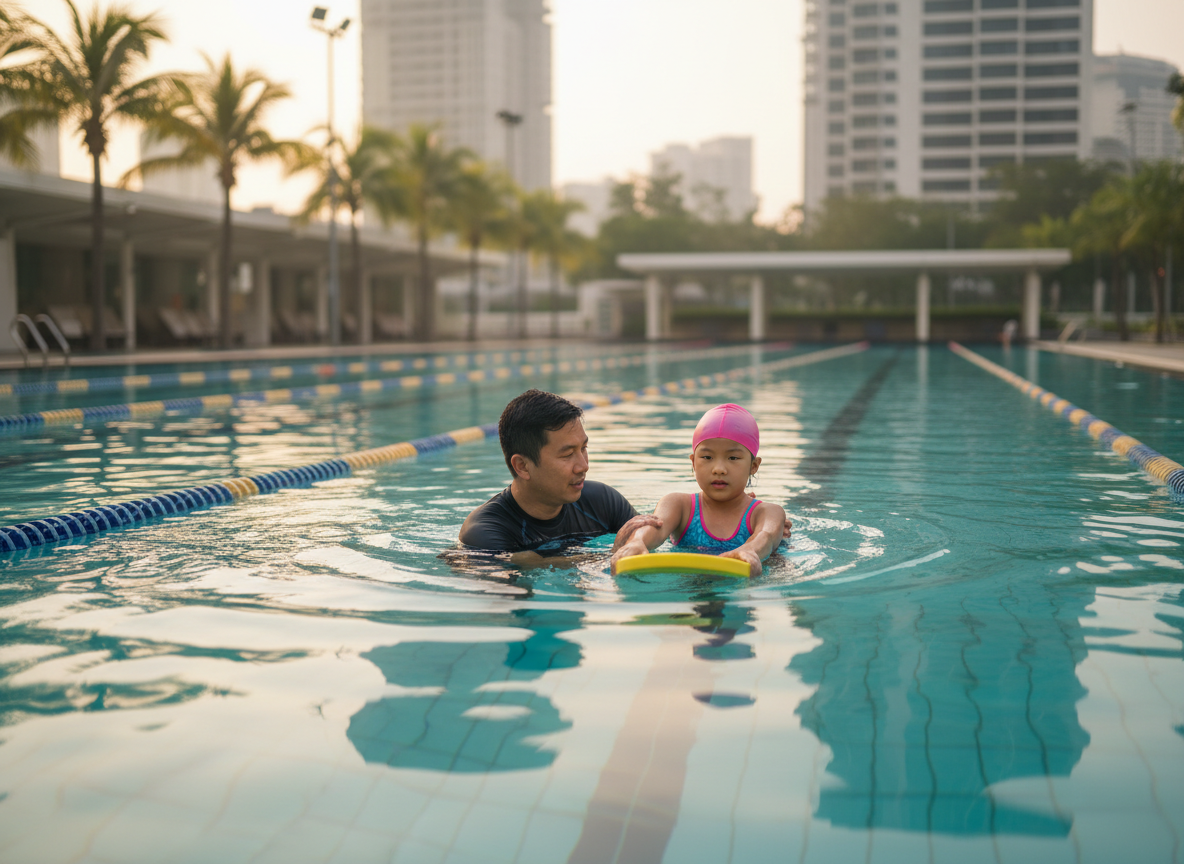
Here is the uncomfortable truth from a coach who has taught a lot of nervous adults: most people asking about 40 metres cannot comfortably swim 200 metres on the surface. Depth ambitions are running ahead of water competence.
Before you sign up for any dive course, build this sequence:
- Be genuinely calm floating. If you cannot rest on your back and breathe slowly for two minutes, your baseline anxiety in water is too high. Start with learning to float properly.
- Swim 200 metres unaided, any stroke, no stopping. This is the standard most agencies use. Slow is fine. Stopping is not.
- Tread water for ten minutes. Again, an agency standard, and a fair measure of whether you can wait calmly for a boat.
- Get comfortable with your face in the water. Not tolerating it — comfortable. If you flinch when water touches your nose, a mask flood at 25 metres will not go well.
- Learn to clear your ears gently, on land first. Equalise early and often on descent. If it hurts, stop and ascend a little. Forcing it damages your ears.
- Then, and only then, take a certification course with a recognised agency, in a pool, with an instructor.
If the foundational pool skills feel out of reach, that is useful information rather than a verdict. A suitable coach can help assess water comfort and recovery skills, but lesson format does not guarantee faster progress. Contact us with your current swimming ability and goal to discuss whether an available pool-based lesson is appropriate; scuba and freediving instruction require separately qualified providers.
Common Mistakes People Make About Depth
- Treating 40 metres as a goal rather than a ceiling. It is the outer edge of recreational practice, not an achievement to tick off.
- Hyperventilating before a breath-hold. It removes your warning system. It has killed strong swimmers in shallow pools.
- Diving after drinking. Alcohol impairs judgement and dehydrates you, and dehydration increases decompression risk. There is no safe amount before a dive.
- Pushing through ear pain. Pain on descent means stop and ascend. It does not mean try harder.
- Assuming fitness equals water competence. Runners and cyclists drown too. Water skill is its own skill.
- Diving on a holiday “discover scuba” session with no swimming background. These are supervised and generally shallow, but people badly overestimate what they can handle when a mask fills.
- Solo breath-hold training in a lap pool. The single most preventable death in swimming pools. Never alone.
A Word on the Ocean Itself
Depth is not only a physiological question. Divers touching coral, kicking up sediment, or crowding reef life do measurable damage. Good buoyancy control — the ability to hover without touching anything — is the mark of a competent diver, and it is learned in a pool long before it is used on a reef.
Frequently Asked Questions
How deep can a human dive without any training?
Practically, not deep at all, and you should not try. An untrained person can duck-dive a few metres. Beyond that, ear equalisation, buoyancy and breath management all need instruction. Depth without training is not brave, it is just uninformed.
What is the safe limit for recreational scuba diving?
Around 40 metres, with the practical working range for most certified divers sitting well above that. Beyond 40 metres you enter territory requiring technical training, different gas mixes and mandatory decompression stops.
Why is shallow-water blackout so dangerous?
Because it gives no warning and happens near the surface, where a swimmer looks fine right up until they are not. It typically follows hyperventilation before a breath-hold. Direct, in-water supervision is the only reliable protection.
Do I need to be a strong swimmer to learn to dive?
You need to be a competent one. Most agencies ask for a 200-metre swim and ten minutes of treading water. Speed is irrelevant. Calmness is everything, and calmness comes from practice.
Can children learn to dive?
Junior certifications exist with strict depth limits and adult supervision requirements. Before that, the priority is water confidence and stroke competence, not depth. A child who can swim well and enjoys the water will take to diving later without difficulty. There is no advantage to rushing.
Is freediving deeper than scuba diving?
Elite freedivers have reached greater depths than most scuba divers ever will, on a single breath. This says a great deal about extreme human adaptation and nothing at all about what is sensible for a recreational swimmer. Treat those records as remarkable, not as a template.
Where This Leaves You
The depth a human can reach is a genuinely interesting question with a genuinely boring answer for most of us: far deeper than we should ever go. What is worth your attention is the water competence underneath the question. Comfort, calm breathing, honest self-assessment, and someone watching when you practise anything involving breath.
If you are building that foundation, start with appropriate pool-based instruction and keep diving-specific training with a qualified diving provider. Contact us about foundational swimming skills. For pool locations and public facilities, ActiveSG lists what is available nationwide.
The ocean is not going anywhere. Build the skills first.
🏊 From the Pool Deck — Our Coaching Experience
Having guided over 5,000 swimmers across Singapore since 2015 — from adults who feared the water to children aiming for SwimSafer Gold — every tip and recommendation in this article comes directly from our coaches’ real-world experience at poolside. We coach weekly at condominiums, public pools, and private facilities islandwide, and we update our content to reflect what we actually see working for Singapore swimmers today.
📚 Official Sources & Further Reading
About This Article
Written by the PrivateSwimming.sg coaching team — AUSTSWIM-certified instructors and Singapore Lifesaving Society (SLSS) members who have personally coached over 5,000 swimmers across Singapore since 2015, from anxious beginners to competitive teenagers preparing for SwimSafer Gold. Our coaches hold current First Aid and CPR certifications and operate under Singapore’s Child Protection (Vulnerable Persons) framework. Our swim curriculum is aligned with Sport Singapore’s SwimSafer 2.0 programme, the Singapore Swimming Association (SSA) coaching standards, and the Health Promotion Board (HPB) active living guidelines.
✔ AUSTSWIM Certified | ✔ SLSS Qualified | ✔ SwimSafer 2.0 Educators | ✔ 5,000+ Swimmers Coached Since 2015 | ✔ Sport Singapore Aligned | ✔ SSA Coaching Standards | Last reviewed: September 2026


Leave a Comment