

Adult beginners progress at very different rates. A useful sequence is to build calm submersion and recovery first, then floating, breathing and short supported strokes before adding distance. The milestones below are examples rather than promises; confidence, health, practice frequency and prior water experience all affect the pace.
Fitness on land does not automatically create comfort in water. If you want to dive into fitness through the pool, treat the sequence below as a flexible skills framework and ask a coach to adapt it to your starting point.
Gear: Buy Three Things, Ignore the Rest
You need a swimsuit that stays on, goggles that seal, and a cap if you have long hair. That is the whole list.
Goggles are the one thing worth spending on. Press a lens to your eye socket without the strap. If it holds for a second by suction alone, the shape fits your face. If it falls off, no amount of strap tightening will stop the leaking, and you will spend every lesson emptying them instead of learning. Fins, paddles and pull buoys can wait — they compensate for technique you have not built yet.
Comfortable pool access matters more than equipment. A pool you will actually go to beats a better pool you will not.
Milestone 1: Submersion, Recovery and Supported Floating
Tension can make balance and breathing harder. Begin by practising calm submersion, standing recovery and supported floating in water where you can stand, with suitable supervision.
Stand in chest-deep water. Exhale slowly through your nose with your face in. Come up. Repeat until it is boring. Then lie back, ears in the water, chin lifted slightly, and breathe normally. Your hips will drop at first. Let them. Do not kick to fix it.
Spend real time here. Everything downstream depends on it. If back floating is not coming, work through floating technique in detail before moving on.
Milestone 2: Breathing on a Rhythm
Almost every beginner holds their breath underwater and then tries to inhale and exhale in the same brief turn of the head. It cannot be done, and it is why people finish a length gasping.
The rule: exhale continuously while your face is in the water. Bubbles, the whole time. Turn the head, and the lungs are already empty, so the inhale takes a fraction of a second.
Practise holding the pool edge, face down, blowing out. Turn to breathe. Face back in, blow out. Twenty repetitions, then rest. It feels tedious. It is the difference between swimming and surviving.
Exhale in the water, inhale in the air. Never both in the air.
Milestone 3: Short Supported Strokes
Start with backstroke, not front crawl. Your face is out of the water, so breathing is solved, and you can concentrate on body position. Then move to front crawl once the breathing rhythm from week four is automatic.
For both, the priorities are the same and in this order: level hips, long body, quiet legs, then arms. Beginners kick furiously and go nowhere. A small, loose kick from the hip — not the knee — does the job.
Breaststroke often feels easiest because the head stays up, but it hides bad habits and is hard on the knees when the kick is wrong. Learn it, but not first. When you do, get the timing and kick checked by a coach — breaststroke knee pain is a coaching failure, not a fitness one.
A Flexible Beginner Progression
| Stage | Focus | What success looks like | Common trap |
|---|---|---|---|
| Foundation | Submersion and floating | Supported float with calm breathing and a safe standing recovery | Kicking to stop the hips sinking |
| Breathing | Rhythmic breathing | Twenty turns without gasping | Holding breath underwater |
| Short strokes | Backstroke, then front crawl | 15 metres, relaxed | Furious kicking, lifting the head |
| Distance | Continuous swimming | 25 metres without stopping | Sprinting, then quitting at 15 |
Milestone 4: Building Distance Without Building Panic
Increase distance before you increase speed. Swim slower than feels natural. A beginner who can cover 25 metres calmly is in a far better position than one who can sprint 15 and then hangs on the wall.
Sensible progression: four lengths with rest, then six, then eight. Add a length or two per week, not per session. If your stroke falls apart in the last length, you have added too much.
Mistakes I See Every Single Term
- Lifting the head to breathe. Head up means hips down means legs sinking. Rotate; do not lift.
- Kicking from the knee. Bicycle legs create drag. The kick starts at the hip.
- Holding the breath. The root cause of most beginner exhaustion.
- Training tired. Technique learned when exhausted is bad technique, learned permanently.
- Skipping the float work because it feels like it is not real swimming. It is the only part that is not optional.
- Comparing yourself to the fast lane. They started where you are.
- Practising breath-holding to “build lung capacity.” Do not. See below.
Safety, Which Is Not Optional
- Never swim alone as a beginner. A lifeguard scanning a busy pool is not the same as someone watching you.
- Do not practise breath-holding or underwater distance. Hyperventilating before a breath-hold can cause shallow-water blackout — loss of consciousness without warning, in water shallow enough to stand in. It kills fit, capable swimmers. If any breath-hold work happens, a dedicated buddy must be at arm’s reach, watching only you.
- Never drink before swimming. Alcohol and water are a genuinely dangerous combination, not a relaxed one.
- Children are supervised at all times, within arm’s reach. Armbands, rings and noodles are toys, not safety devices.
- Shoulder or knee pain means stop and see a physiotherapist. Do not push through it. Swimming through joint pain reliably makes it worse.
- Know the pool rules and depth markings before you get in. Read the Sport Singapore water safety guidance if you are new to public pools.


Frequently Asked Questions
Am I too old to learn to swim?
Adults can learn later in life, but health, mobility, confidence and prior experience affect the appropriate pace. Discuss relevant conditions with a healthcare professional and ask the coach to adapt entries, exits, rests and goals.
How often should a beginner swim?
A regular schedule can help, but the right frequency depends on recovery, budget, access and goals. One well-structured session plus safe practice may suit some learners; others prefer more frequent coaching.
Why do my legs sink?
Head position, breathing, body shape and individual buoyancy can all contribute. Practise with support in shallow water and ask a coach to identify the main cause rather than forcing the legs upward.
Should I take group classes or private lessons?
Groups can suit learners who enjoy a shared pace and may cost less. Private lessons can suit learners who want individual pacing or a quieter setting. Neither format guarantees faster progress; choose according to confidence, budget, coach quality and the amount of individual feedback available.
Do I need to be fit before I start?
No. Swimming builds the fitness it requires. Turning up unfit and slow is the normal starting point, not a disadvantage.
How long until I can swim properly?
There is no reliable fixed timeline. Some learners reach a relaxed 25 metres quickly, while others need longer to build confidence, breathing control or recovery skills. Ask for a baseline assessment and review progress by observable milestones rather than a promised date.
Start Where You Actually Are
The pool does not care that you are nervous, and it does not care that you are unfit. It only responds to whether you relax. Begin with floating, stay there longer than feels reasonable, and let the strokes arrive on their own schedule.
If you would rather not work it out alone, that is what swimming lessons in Singapore exist for. One stroke at a time.
🏊 From the Pool Deck — Our Coaching Experience
Having guided over 5,000 swimmers across Singapore since 2015 — from adults who feared the water to children aiming for SwimSafer Gold — every tip and recommendation in this article comes directly from our coaches’ real-world experience at poolside. We coach weekly at condominiums, public pools, and private facilities islandwide, and we update our content to reflect what we actually see working for Singapore swimmers today.
📚 Official Sources & Further Reading
About This Article
Written by the PrivateSwimming.sg coaching team — AUSTSWIM-certified instructors and Singapore Lifesaving Society (SLSS) members who have personally coached over 5,000 swimmers across Singapore since 2015, from anxious beginners to competitive teenagers preparing for SwimSafer Gold. Our coaches hold current First Aid and CPR certifications and operate under Singapore’s Child Protection (Vulnerable Persons) framework. Our swim curriculum is aligned with Sport Singapore’s SwimSafer 2.0 programme, the Singapore Swimming Association (SSA) coaching standards, and the Health Promotion Board (HPB) active living guidelines.
✔ AUSTSWIM Certified | ✔ SLSS Qualified | ✔ SwimSafer 2.0 Educators | ✔ 5,000+ Swimmers Coached Since 2015 | ✔ Sport Singapore Aligned | ✔ SSA Coaching Standards | Last reviewed: September 2026
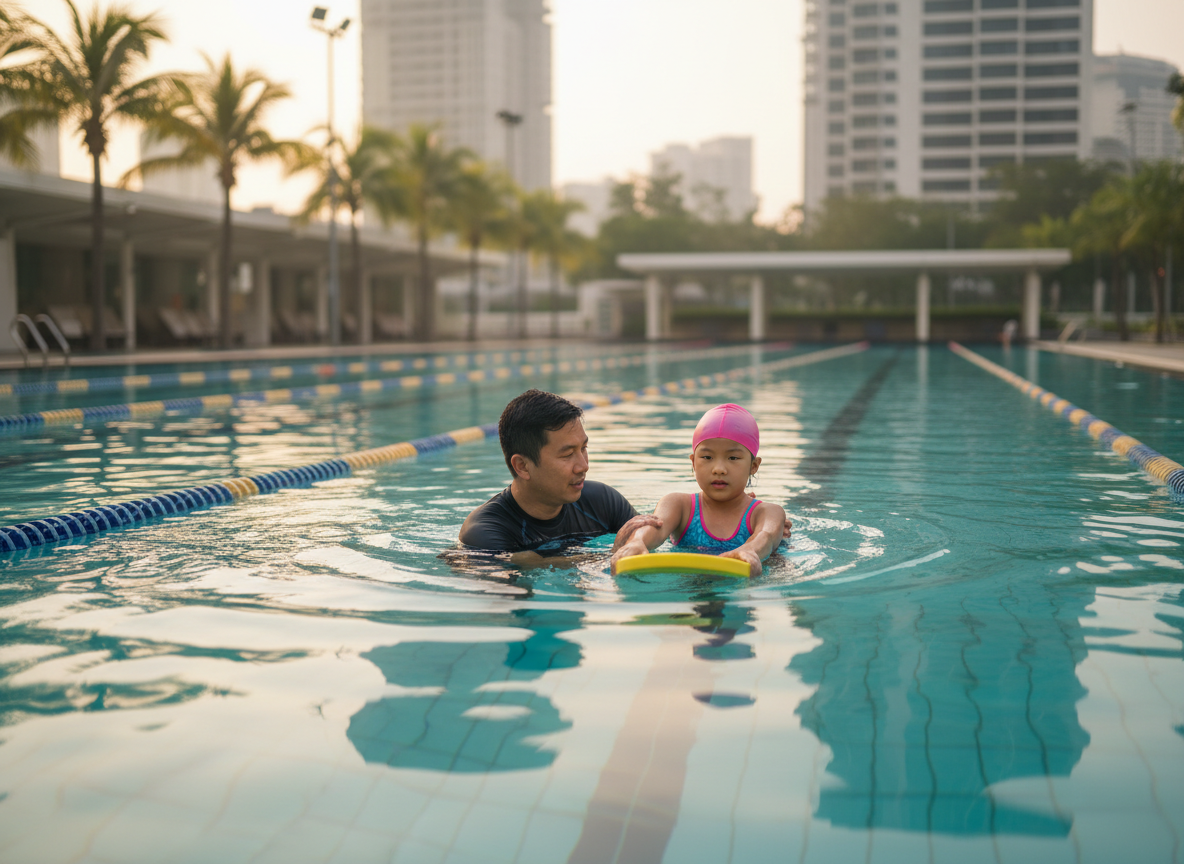


[…] is worth the cost specifically because you can be honest about fear without an audience. Our beginner’s eight-week guide sets out what the first sessions look like, and lessons for ladies covers arrangements in more […]
[…] Most triathletes’ “fitness problem” in the swim is a breath-holding problem. Our beginner sequence covers […]