

When you decide to learn swimming — or to get your child started — the first real decision is not which stroke to begin with. It is whether to go private or join a group. Both approaches have genuine merit. Both have real limitations. The answer that works for you depends on your goals, your schedule, your budget, and the way you learn best.
This guide lays out the honest differences, so you can make a call that actually lasts.
What Private Swimming Lessons Actually Mean
Private swimming lessons pair you with one dedicated coach for the full duration of every session. There are no other swimmers competing for the coach’s attention. Every drill, every correction, and every piece of feedback is directed at you alone.
In Singapore, private lessons typically take place at:
- Your condominium pool (many residents use their condo facility without any extra booking fee)
- A public swimming complex managed by Sport Singapore
- A friend’s condo or a hired lane at a commercial pool
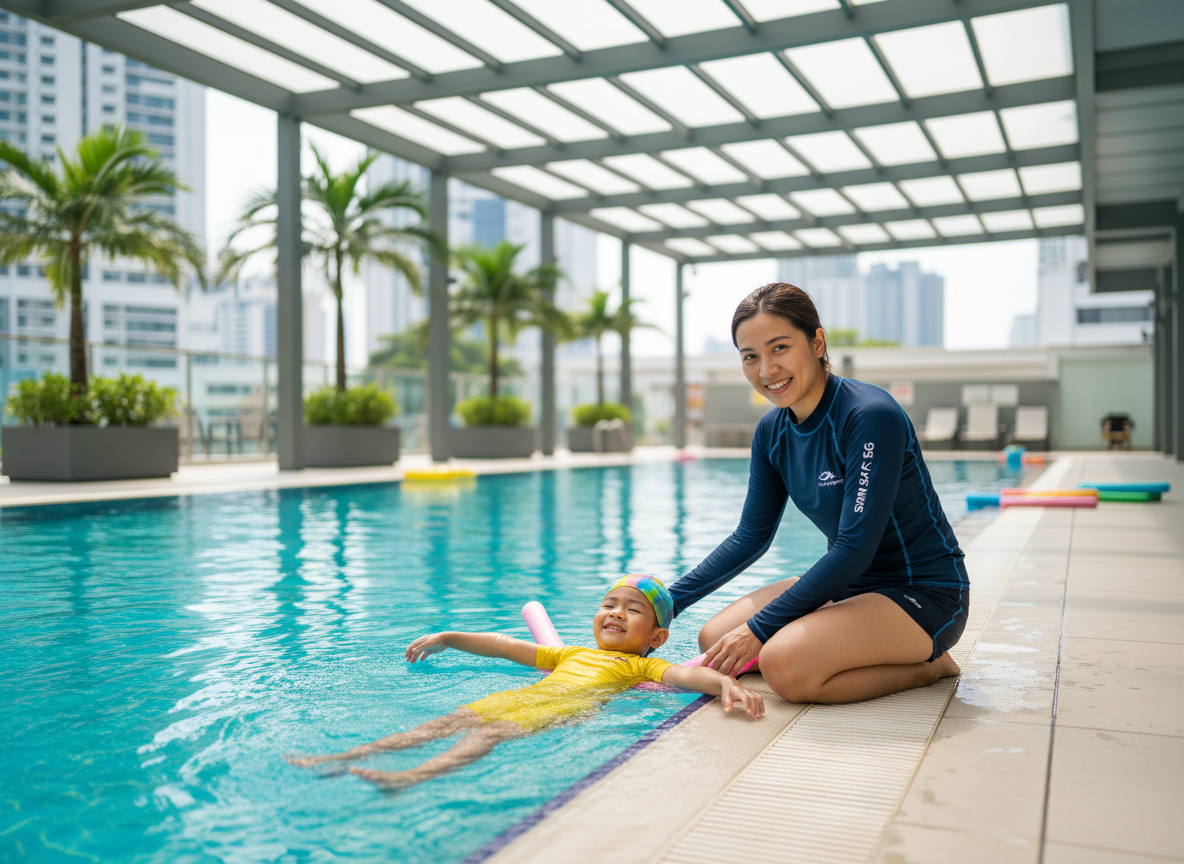
At PrivateSwimming.sg, coaches travel to the learner. Sessions happen at your condo pool or another agreed venue anywhere in Singapore. The coach, the space, and the lesson plan belong entirely to you.
What Group Swimming Lessons Look Like
Group lessons bring together several swimmers of similar age or ability. Class sizes in Singapore commonly run from four to eight people, though some community programmes manage larger batches. The coach works the lane and divides attention among everyone.
This is the format most Singaporeans grew up with — school swim programmes, community centre classes, holiday camps. Resources listing swimming classes across Singapore show a wide range: weekend squads, weekday morning sessions, adult beginner batches, and SwimSafer certification courses run in this format.
The Key Differences, Side by Side
Pace of Learning
Private lessons let the coach move exactly as fast — or as slowly — as you need. If you master kicking in one session, the next session introduces arm coordination. If your fear of putting your face underwater needs two extra weeks of patience, there is no group timeline pressuring the coach to move on.
Group classes follow a shared syllabus. The pace is set to suit the middle of the group, which may feel too fast for anxious beginners and too slow for quick learners.
Immediate Feedback
In a one-to-one lesson, the coach sees every stroke. Errors — a dropped elbow, a scissor kick, a held breath — are corrected the moment they appear, before they become habits. In a group, you may complete an entire length before the coach has time to reach you.
Habit formation in swimming is powerful. A mistake made 200 times before correction is far harder to undo than one caught on the third attempt. This is why stroke correction almost always happens faster in private lessons.
Flexibility and Scheduling
Private sessions can be booked around your calendar. Early morning before work, weekday afternoons during school hours, Sunday evenings — most private coaches accommodate requests that group timetables cannot. This matters especially for adults with unpredictable schedules and parents managing multiple children’s activities.
Cost
Group lessons are cheaper per session. A group class in Singapore typically costs between $25 and $60 per person per session, depending on the pool and the school. Private lessons run higher — typically $80 to $160 per session — reflecting the exclusive attention and flexible scheduling.
Over time, the gap may be smaller than it first appears. If a swimmer achieves in eight private lessons what might take twenty group classes, the effective cost difference narrows considerably.
Social Experience
Some learners — particularly children — thrive on the energy of a group. Swimming alongside peers, cheering each other on, and having classmates at the same level can make the experience more enjoyable and motivating. Adults who enjoy social exercise may feel similarly.
Private lessons are quieter and more focused. There is less room to hide, which is both a challenge and an accelerator.
Who Gets the Most from Private Lessons?
Private lessons tend to deliver the clearest advantages for:
Adults starting from scratch. Learning to swim as an adult often carries anxiety that benefits from undivided, patient attention. Adult swimming lessons at your own pace, without the self-consciousness of a group setting, lower the barrier considerably.
Women who prefer a female-only environment. Many women in Singapore are more comfortable with a private arrangement or ladies-only swimming lessons, where they can wear modest swimwear and learn without the social pressure of a mixed group.
Learners with additional needs. Swimmers with autism, sensory sensitivities, physical differences, or developmental delays often benefit significantly from one-to-one coaching. The coach can adjust pacing, communication, and technique in ways a group format cannot accommodate. Organisations like specialneeds.com.sg highlight this need, and our own special-needs swimming programme reflects the same understanding.
Children who need confidence building. A child who is timid in water, or one who has had a frightening experience, often flourishes when the coach’s full attention is on them. Private kids’ swimming lessons allow the pace to match the child’s readiness, not a syllabus deadline.
Experienced swimmers refining technique. Competitive or recreational swimmers who want stroke correction — not basic instruction — need a coach’s eyes on their specific mechanics, not a shared lane session.
Who Gets the Most from Group Lessons?
Group lessons work well for:
- Children already comfortable in water who benefit from learning alongside peers
- Budget-conscious families for whom group lessons are a practical first step
- Learners preparing for SwimSafer certification, which many schools deliver in group format
- Adults who enjoy social exercise and have no particular urgency about pace
Finding the Right Lessons in Singapore
There is no shortage of options. Sites like singaporeswimminglessons.sg list school and community programmes across the island. swim2u.sg offers both private and group formats. Swimmingnearme.sg helps you locate sessions close to your home or condo. For a broader look at accredited schools, swimschoolsinternational.sg covers international standards and certifications.
If you are weighing up coaching qualifications specifically, swimmingcoach.sg and swimminginstructorcourse.sg explain what to look for in a certified instructor. For facility-specific information, swimmingcomplex.sg is a useful reference for pool details across Singapore.
For condo-based lessons in particular, condoswimming.sg breaks down what to expect when using your estate’s pool for professional coaching.
PrivateSwimming.sg offers private and one-to-one coaching for adults, kids, toddlers, ladies, and learners with special needs — with certified coaches who come to you across Singapore. You can reach out via the contact page to discuss which format suits your situation.
Outside of swimming, this team is part of a broader network of Singapore service providers: hometuition.com.sg for academic home tutoring, aircon2u.sg for residential air-conditioning servicing, and marketingagency.com.sg for digital marketing support.
Frequently Asked Questions
Can I start with group lessons and switch to private later?
Yes, and many learners do exactly this. Group lessons can cover the basics; private lessons then address specific weaknesses or speed up technique refinement.
At what age can a child start private swimming lessons?
Most coaches in Singapore work with children from around 18 months to two years old, with a parent in the water. Solo private lessons typically start from three to four years, depending on the child’s confidence and temperament.
Is it better to have lessons daily, or once a week?
More frequent lessons build muscle memory faster, especially at the start. Two to three times a week is the sweet spot for children. For working adults, once a week is more practical and still produces consistent progress over time.
Do private coaches bring their own equipment?
Most bring essential teaching aids — kickboards, floats, pull buoys. You may be asked to supply your own goggles and swimwear. Confirm with your coach before the first session.
Can private lessons happen at any condo in Singapore?
Most condominiums allow lessons with a visiting certified coach, though some estates require prior approval from management. Coaches who work at condos regularly will know the requirements for pools in their area.
How long does it take an adult to learn to swim?
A motivated adult who attends consistently can swim a length with reasonable technique in eight to fifteen private sessions. Those who start with significant water anxiety may take a little longer — and that is entirely normal progress.
Are private lessons worth it for toddlers?
For very young children, the benefit is less about stroke technique and more about water confidence, safety awareness, and positive association with the pool. Private lessons allow a coach to move at a toddler’s emotional pace, which varies enormously from child to child. See our toddler swimming lessons page for more detail.
How do I check if a coach is qualified?
Look for certification under Singapore’s national coaching accreditation scheme or internationally recognised swimming instructor qualifications. The swimminginstructorcourse.sg site explains the certification pathway in detail.
The Bottom Line
Neither private nor group lessons are universally better. The right choice depends on where you are starting from, how fast you want to progress, and what you can commit to in time and budget.
If you want faster results, personalised feedback, and the flexibility of lessons that fit your schedule — and you have the budget to support it — private lessons are the more efficient path for most learners in Singapore. If cost is the main constraint and you or your child learn well alongside others, a quality group programme is still a strong foundation.
The clearest signal of a trustworthy coach or school is that they will tell you honestly which format suits your situation — even if that means pointing you toward a less expensive option.
🏊 From the Pool Deck — Our Coaching Experience
Having guided over 5,000 swimmers across Singapore since 2015 — from adults who feared the water to children aiming for SwimSafer Gold — every tip and recommendation in this article comes directly from our coaches’ real-world experience at poolside. We coach weekly at condominiums, public pools, and private facilities islandwide, and we update our content to reflect what we actually see working for Singapore swimmers today.
📚 Official Sources & Further Reading
About This Article
Written by the PrivateSwimming.sg coaching team — AUSTSWIM-certified instructors and Singapore Lifesaving Society (SLSS) members who have personally coached over 5,000 swimmers across Singapore since 2015, from anxious beginners to competitive teenagers preparing for SwimSafer Gold. Our coaches hold current First Aid and CPR certifications and operate under Singapore’s Child Protection (Vulnerable Persons) framework. Our swim curriculum is aligned with Sport Singapore’s SwimSafer 2.0 programme, the Singapore Swimming Association (SSA) coaching standards, and the Health Promotion Board (HPB) active living guidelines.
✔ AUSTSWIM Certified | ✔ SLSS Qualified | ✔ SwimSafer 2.0 Educators | ✔ 5,000+ Swimmers Coached Since 2015 | ✔ Sport Singapore Aligned | ✔ SSA Coaching Standards | Last reviewed: September 2026
Leave a Comment