

If your child freezes at the pool edge, clings to you when water reaches their waist, or bursts into tears at the thought of putting their face in — you are not alone. Water confidence is a skill, not a personality trait, and it can be gently developed with the right approach, the right environment, and a patient swimming coach. This guide walks you through the why and the how of helping your child feel genuinely at ease in the water.
Why Some Children Struggle with Water Confidence
Fear of water in children is more common than most parents realise, and it rarely has a single cause. Understanding where the anxiety comes from is the first step to addressing it effectively.
Normal Developmental Fear
Babies who once splashed happily in the bath often become more cautious between the ages of two and five. This is developmentally normal — children at this age are growing more aware of danger and their own physical limitations. A healthy level of water caution is a protective instinct; the goal is not to eliminate caution altogether, but to replace blind fear with confident awareness.
Past Negative Experiences
A sudden dunk, an unexpected splash to the face, or watching another child struggle in the water can leave a lasting impression. Children are highly observant, and a single distressing episode can set back weeks of progress. This is why children’s swimming lessons that move at a child-led pace matter so much — one bad session in a group class can undo a great deal of patient work.
Group Lesson Pressure
Many children who appear “afraid of water” are actually overwhelmed by the group class environment. Noise, crowds, waiting turns, and the feeling of being watched can overwhelm a child who might be perfectly content splashing quietly with a trusted adult. If your child does well in casual pool visits but struggles in class, the setting — not the water — may be the real issue.
Signs Your Child Is Ready to Progress
Water confidence does not appear overnight. Progress is gradual, and knowing what to look for helps. Positive signs include:
- Willingness to enter the water without prolonged coaxing
- Enjoying water play such as pouring, splashing, or kicking on the steps
- Accepting water on the face during bath time without distress
- Showing curiosity about what lies below the surface
- Initiating pool visits rather than dreading them
Each of these is a genuine milestone. Acknowledging them sends a powerful signal to your child that they are making real progress.
Practical Ways to Build Swimming Confidence
Start with Water Play, Not Formal Lessons
Jumping straight into structured lessons before a child is comfortable in the water often backfires. Begin with unstructured water time: shallow paddling pools, the steps of a condo pool, water tables, or bath play. The goal is simple — your child should associate water with something enjoyable. According to the Health Promotion Board, active play in water supports children’s motor development and emotional regulation simultaneously.
Let Your Child Set the Pace
Resist the urge to push. Children who feel in control of how quickly they progress tend to move faster than those who are hurried. Let your child decide when to dip their face in, when to try floating, when to move away from the wall. Sport Singapore emphasises child-centred approaches to aquatic learning, recognising that coercive methods increase anxiety rather than reduce it.
Celebrate Small Milestones
Water confidence is built in increments. A child who wets their face for the first time has achieved something real. Low-key praise — a high-five, a calm “you did that!” — reinforces the child’s belief in their own ability without creating performance pressure.
Use Familiar Objects
A favourite waterproof toy, a brightly coloured kickboard, or a pair of properly fitted swimming goggles can reduce anxiety considerably. Goggles help children who fear water in their eyes, making face submersion feel safe. Our coaches at PrivateSwimming.sg’s toddler swimming lessons often introduce goggles early to build comfort before any formal technique work begins.
The Role of a Private Swimming Coach in Building Confidence
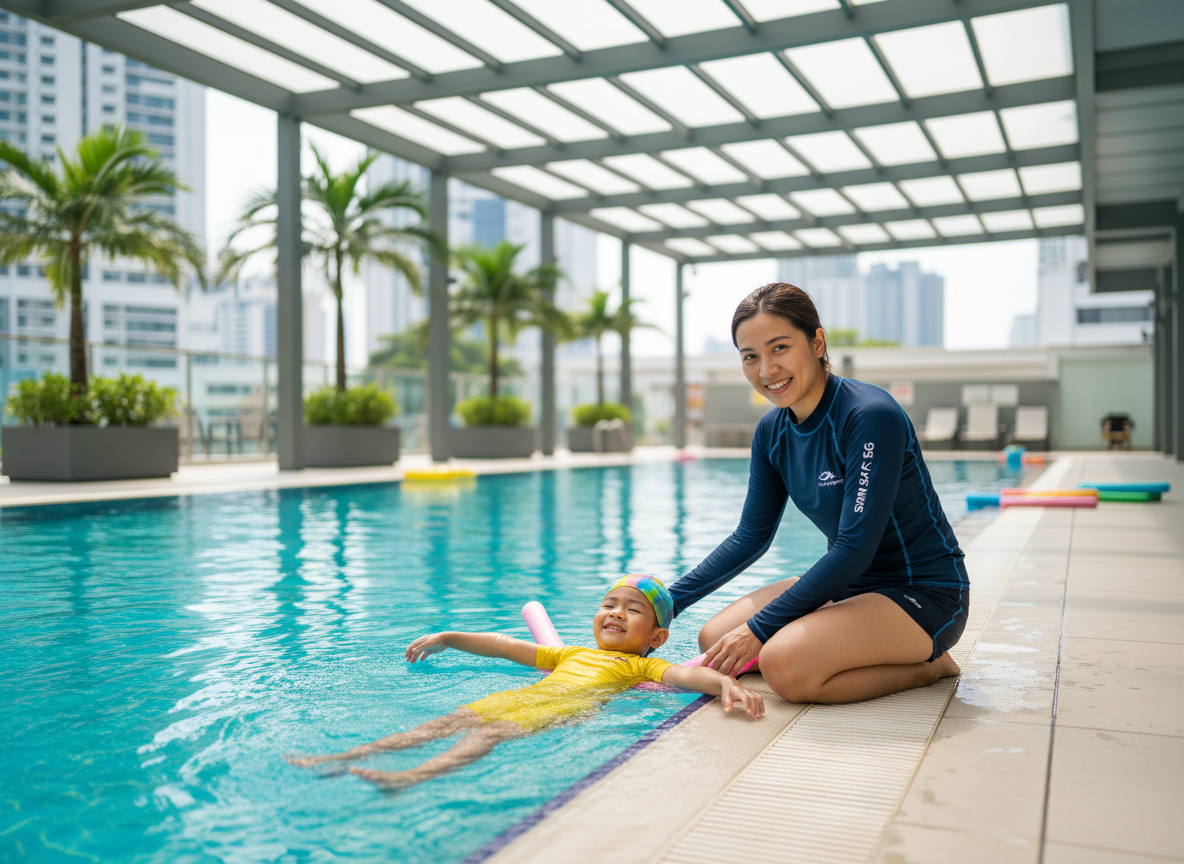
Group classes work well for confident swimmers, but for a nervous or reluctant child, one-to-one attention changes everything. A private swimming coach can adapt sessions in real time, slow down when anxiety rises, pivot to play when the child needs a break, and build a genuine rapport that makes progress feel safe.
At PrivateSwimming.sg, our certified coaches have experience with children who have had negative group class experiences, children with special learning needs, and beginners who have never been in a pool before. Lessons can be conducted at your condo pool, a community pool, or a private facility — whichever feels most comfortable. We serve families across Singapore, with flexible scheduling around school hours and family routines.
Once your child is ready, our coaches can also integrate SwimSafer preparation into confidence-building sessions. The Singapore Lifesaving Society highlights that genuine water confidence is a prerequisite for meaningful survival swimming skills.
Pool Activities That Build Confidence Gradually
Time in the water with you is irreplaceable. Children learn courage partly by watching trusted adults enjoy something that feels scary. Activities that work well:
- Bubble blowing: Put your mouth at water level and blow bubbles. Invite your child to copy you. This is the most important precursor to breath control in swimming.
- Kickboards and noodles: Let your child experiment with floatation independently. The sensation of buoyancy without parental support is quietly empowering.
- Treasure diving: Drop a smooth, brightly coloured object into shallow water and let your child retrieve it. Curiosity overrides water anxiety surprisingly quickly.
Across Singapore’s aquatics network, parents will find useful background reading. Swim2u and Singapore Swimming Lessons cover learning progressions well. Swimming Instructor Course SG explains what certified coaches are trained to deliver. Directories such as Swimming Complex SG and Swimming Near Me help you find facilities nearby, while Swim Schools International offers comparative programme information. Our wider partner network also includes Swimming Coach SG, Condo Swimming SG, Swimming Classes SG, Special Needs SG, Home Tuition SG, Aircon2u, and Marketing Agency SG.
Common Mistakes Parents Make
- Making the pool a battleground: Arguments before or during pool visits create negative associations. If a session is going badly, stop and try again another day.
- Comparing siblings: “Your brother was swimming by age four” is never helpful. Children develop water confidence on entirely different timelines.
- Skipping lessons when life gets busy: Consistency matters far more than intensity. A thirty-minute weekly lesson builds far more confidence than a monthly two-hour session.
- Over-relying on floatation devices: Arm bands and inflatable rings are fine for play, but they delay a child’s sense of their own buoyancy if used every session.
What to Expect at a First Private Lesson in Singapore
A first lesson at PrivateSwimming.sg — whether for a toddler, a school-age child, or a teenager who has avoided the pool for years — is focused on comfort, not technique. Your coach will learn your child’s previous experience, spend the opening minutes on water play to gauge comfort levels, and adapt the session completely. There is no pressure to put their face in or to do anything that does not feel safe. The lesson follows the child. For children with specific learning needs, our team of coaches will discuss your child’s profile with you before the first session.
Frequently Asked Questions
What age should my child start swimming lessons in Singapore?
Most children are ready for water familiarity activities from around 18 months, and for more structured lessons from age three or four. There is no wrong age to start — children who begin at six or seven often progress quickly once they are developmentally ready and emotionally willing.
My child screams the moment we arrive at the pool. What should I do?
Do not force entry into the water. Spend a few visits simply sitting at the pool edge, letting your child observe the environment without any expectation of getting in. Desensitisation is a gradual process, and a private coach experienced with anxious learners can help you plan this progression.
How long does it take to build swimming confidence?
This varies enormously. Some children become comfortable in two or three sessions; others need several months of regular, patient exposure. Key factors include temperament, prior experience, lesson frequency, and the quality of the coaching relationship.
Is it better to have a female swimming coach for my daughter?
Many families request female coaches, particularly for older girls and teenagers. PrivateSwimming.sg has certified female coaches available for children’s lessons and ladies-only swimming where a female coach is preferred.
Do we need special equipment before the first lesson?
A swimsuit, towel, and water bottle are sufficient. Your coach will advise on goggles or kickboards if they become relevant. Avoid arm bands on lesson days — they interfere with the child developing a natural sense of their own buoyancy.
What if my child has autism or sensory sensitivities?
Pool environments can be overwhelming — bright lights, echo, chlorine smell, and unexpected splashes all play a role. Our special needs swimming coaches are trained in adapted aquatics and communication approaches. Early morning or quiet-pool time slots can also help considerably.
Conclusion
Building swimming confidence in a child is one of the most practical gifts a parent can give. Water confidence underpins physical safety, opens the door to lifelong aquatic recreation, and gives a child a genuine sense of their own capability. With consistent, child-led support and the right coaching, virtually every child can learn to feel genuinely at home in the water.
If your child is ready to take the first step, reach out to PrivateSwimming.sg to arrange a first lesson at your preferred pool, at a time that works for your family across Singapore.
🏊 From the Pool Deck — Our Coaching Experience
Having guided over 5,000 swimmers across Singapore since 2015 — from adults who feared the water to children aiming for SwimSafer Gold — every tip and recommendation in this article comes directly from our coaches’ real-world experience at poolside. We coach weekly at condominiums, public pools, and private facilities islandwide, and we update our content to reflect what we actually see working for Singapore swimmers today.
📚 Official Sources & Further Reading
About This Article
Written by the PrivateSwimming.sg coaching team — AUSTSWIM-certified instructors and Singapore Lifesaving Society (SLSS) members who have personally coached over 5,000 swimmers across Singapore since 2015, from anxious beginners to competitive teenagers preparing for SwimSafer Gold. Our coaches hold current First Aid and CPR certifications and operate under Singapore’s Child Protection (Vulnerable Persons) framework. Our swim curriculum is aligned with Sport Singapore’s SwimSafer 2.0 programme, the Singapore Swimming Association (SSA) coaching standards, and the Health Promotion Board (HPB) active living guidelines.
✔ AUSTSWIM Certified | ✔ SLSS Qualified | ✔ SwimSafer 2.0 Educators | ✔ 5,000+ Swimmers Coached Since 2015 | ✔ Sport Singapore Aligned | ✔ SSA Coaching Standards | Last reviewed: September 2026
Leave a Comment