

The Quays Swimming is a multi-pool aquatic centre — a competition pool, leisure water, and teaching space under one roof. Facilities like it confuse newcomers, because the pool you want depends entirely on what you came to do. Lap swimmers belong in the competition pool during designated lane hours. Families belong in the leisure water. Learners belong in the shallow teaching pool with an instructor. Turning up and using whichever pool is nearest is how people have a bad first visit.
What follows applies to The Quays and to any large aquatic centre, including the public complexes across Singapore. The layout differs. The logic does not.
Which Pool, and When
| Pool | Use it for | Do not use it for |
|---|---|---|
| Competition / main pool | Lane swimming, training, squads | Playing, standing, chatting on the wall |
| Leisure pool | Families, splash play, warm water | Lengths — there is nowhere to swim to |
| Teaching pool | Lessons, shallow practice, nervous adults | Fitness swimming |
| Diving pool | Supervised diving only | Anything at all without supervision |
| Aqua fitness sessions | Low-impact classes, rehab, older adults | Nothing; they suit almost everyone |
Check the timetable before you travel. Large centres reallocate pools throughout the day, and the competition pool is frequently closed to the public for club training, galas or lessons. This catches out more visitors than anything else.
Lane Swimming, Explained
Lanes are almost always sorted by speed, marked slow, medium and fast. Choose honestly. Being overtaken every length is unpleasant for you and disruptive for everybody behind you.
- Look before you get in. Watch a lane for thirty seconds and see how quickly people are actually moving.
- Swim anticlockwise, keeping to the right of the lane, unless the sign says otherwise.
- Leave a gap. Five seconds behind the swimmer in front, not two.
- Stop in the corner of the wall. People are turning in the middle.
- Tap a foot once to pass. The swimmer ahead should stop at the wall and let you through. Never overtake mid-length.
- No fins or paddles in a busy lane without checking. They are a hazard to the person behind you.
Learn-to-Swim, and What Good Looks Like
Most aquatic centres run learn-to-swim programmes, and quality varies enormously. Watch a lesson from the balcony before you enrol anybody.
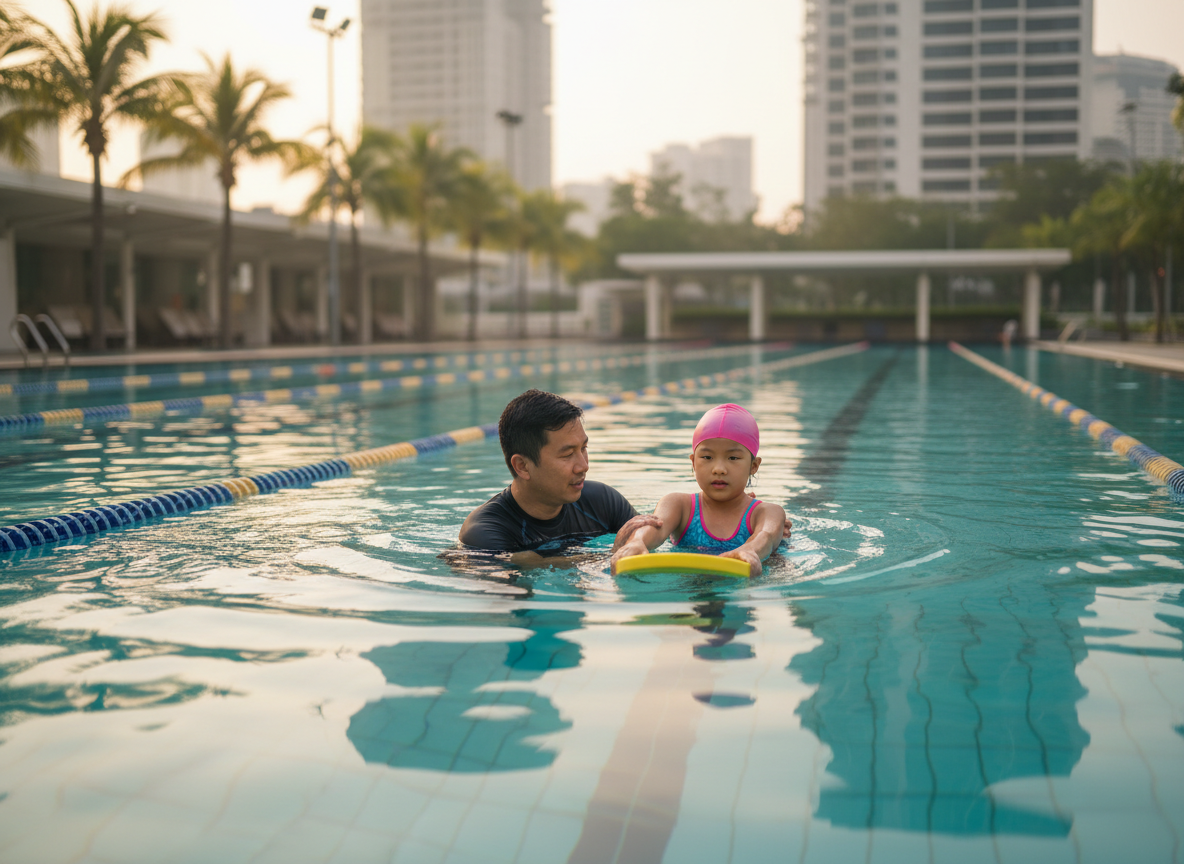
You want a small group — four beginners per instructor at most. You want the coach in the water with absolute beginners, not pacing the deck. You want corrections that name one specific thing, not “kick harder”. And you want floats to come off over time, because aids that never come off mean progress has stopped.
Safety content should appear from the first lesson: how to get out, how to roll onto your back and rest, why you never swim alone.
Bringing Children
Busy aquatic centres are loud, echoing, crowded places. Every condition that makes drowning hard to notice is present.
- Drowning is silent. No shouting, no splashing. The body goes quiet and vertical and slips under.
- Stay within arm’s reach of any child who cannot swim competently, whatever the depth and whatever they are wearing.
- One adult watches, and does nothing else. Hand the role over out loud when you swap.
- Armbands, rings and inflatables are toys. Not safety devices. Use a properly fitted life jacket if the centre provides them.
- Never allow breath-holding contests or underwater distance games. Repeated or prolonged breath-holding, especially after hyperventilating, causes shallow-water blackout — a silent loss of consciousness with no struggle and no warning. It has drowned strong swimmers in lifeguarded pools.
- Feet first, always. No diving except in a supervised diving pool.
- Obey the lifeguards immediately. They can see what you cannot.
Common Mistakes
- Turning up without checking the timetable. The main pool may well be closed to you.
- Choosing the fast lane out of optimism. Everybody in it will know within one length.
- Swimming lengths in the leisure pool. Frustrating, and irritating for the families around you.
- Overtaking mid-length. Do not.
- Treating lifeguards as childminders. They are the last line of defence, not the first.
- Assuming a big facility means good teaching. Watch a lesson before you pay for one.
Making a Big Centre Work for You
Go early. The first hour after opening is quieter, cooler and calmer than any other part of the day, and lane swimming is genuinely pleasant rather than a negotiation.
If you are learning, ask which pool and time the programme uses. A quieter setting may help some nervous adults, while others prefer a group; neither format guarantees faster progress. If you want individual feedback, enquire about private swimming lessons and include the venue’s instructor rules.
In Singapore, ActiveSG publishes timetables, lane hours and programme information for every public complex.
Frequently Asked Questions
Which lane should I choose?
Watch for thirty seconds and pick the one where people are swimming at roughly your pace. When unsure, go slower. It is far easier to move up than to be tapped on the foot every length.
Can I swim lengths in the leisure pool?
Usually not when the area is designated for leisure use or lacks a clear line of travel. Follow the centre’s zoning and use designated lane-swim sessions for uninterrupted lengths.
Do I need to book?
Many centres now require booking for lane sessions and classes. Check before travelling, and check whether the main pool is closed for club training.
What should I bring?
Goggles that fit, a chlorine-resistant suit, a towel, a lock for the locker, and a water bottle. You sweat while swimming and will not notice.
Is a big aquatic centre a good place to learn?
Suitability depends on depth, noise, space, programme rules and the learner’s current comfort. Ask exactly where lessons run and whether that setting matches the learner before enrolling.
Are the diving boards open to the public?
Only during supervised sessions, and rightly so. Never enter a diving pool or use a board outside those hours.
🏊 From the Pool Deck — Our Coaching Experience
Having guided over 5,000 swimmers across Singapore since 2015 — from adults who feared the water to children aiming for SwimSafer Gold — every tip and recommendation in this article comes directly from our coaches’ real-world experience at poolside. We coach weekly at condominiums, public pools, and private facilities islandwide, and we update our content to reflect what we actually see working for Singapore swimmers today.
📚 Official Sources & Further Reading
About This Article
Written by the PrivateSwimming.sg coaching team — AUSTSWIM-certified instructors and Singapore Lifesaving Society (SLSS) members who have personally coached over 5,000 swimmers across Singapore since 2015, from anxious beginners to competitive teenagers preparing for SwimSafer Gold. Our coaches hold current First Aid and CPR certifications and operate under Singapore’s Child Protection (Vulnerable Persons) framework. Our swim curriculum is aligned with Sport Singapore’s SwimSafer 2.0 programme, the Singapore Swimming Association (SSA) coaching standards, and the Health Promotion Board (HPB) active living guidelines.
✔ AUSTSWIM Certified | ✔ SLSS Qualified | ✔ SwimSafer 2.0 Educators | ✔ 5,000+ Swimmers Coached Since 2015 | ✔ Sport Singapore Aligned | ✔ SSA Coaching Standards | Last reviewed: September 2026


Leave a Comment