

Swimming lessons can help children build water competency, but no lesson makes a child “drown-proof”. In Singapore, families may encounter water at condominium pools, public swimming complexes, beaches and water-play areas, so safety needs several layers working together.
This guide explains practical precautions for parents and caregivers. It does not replace advice from a doctor, pool operator, lifeguard or emergency service.
The Short Answer: Use Several Layers of Protection
The most reliable approach combines close adult supervision, controlled access to water, appropriate life jackets, water-safety education, swimming instruction and caregiver readiness to respond in an emergency. No single layer is sufficient.
- Close, attentive supervision: young children and weak swimmers need a capable adult nearby whose attention is on the water, not a phone or another task.
- Controlled access: follow the pool’s gates, barriers and access rules. Do not prop gates open or assume another resident is watching.
- Appropriate flotation: use a properly fitted life jacket when the activity or conditions require one. Inflatable toys and pool noodles are not substitutes.
- Water competency: lessons can develop entry, resurfacing, turning, floating, propulsion and safe exit skills over time.
- Emergency readiness: caregivers should know how to summon help and should consider recognised CPR and rescue training.
What Active Supervision Looks Like
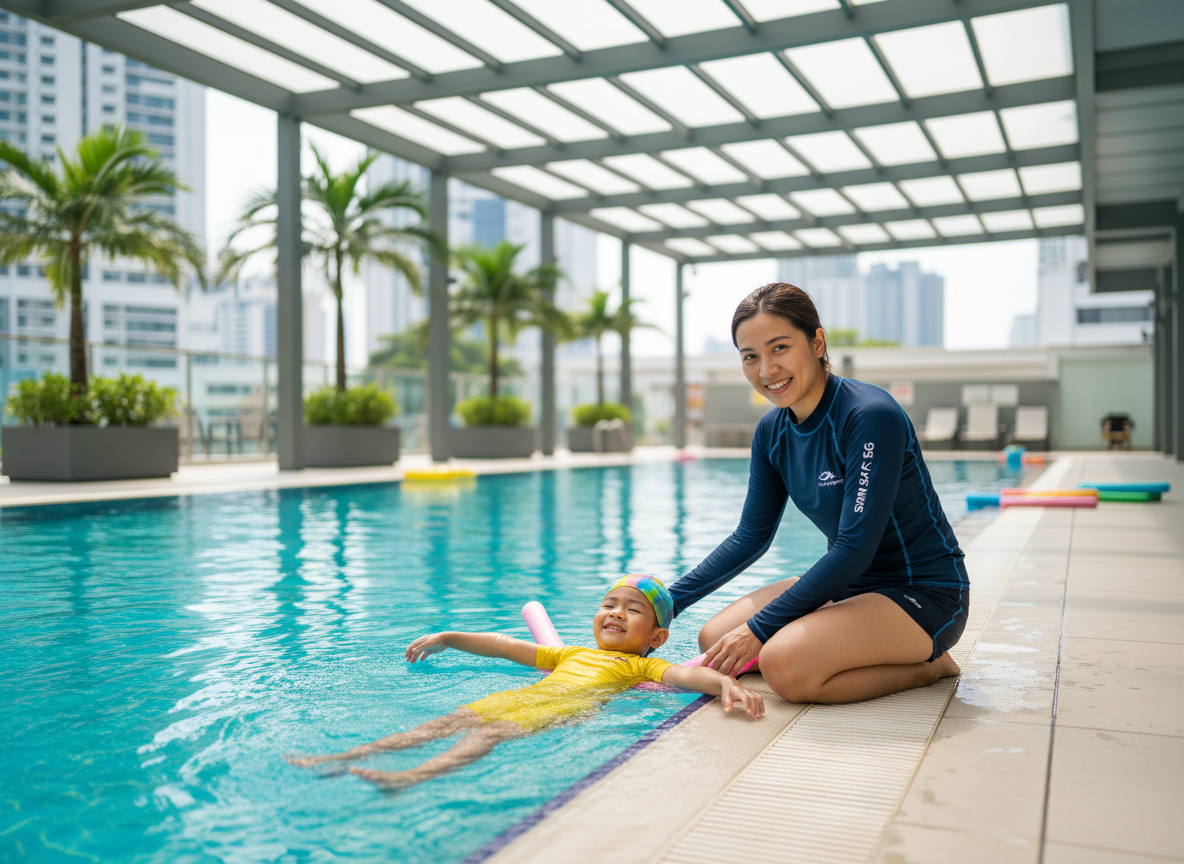
Supervision should be close, constant and appropriate to the child’s ability and the environment. Infants, toddlers and weak swimmers generally need an adult within arm’s reach in or beside the water. Even competent swimmers need clear rules and an adult who knows where they are.
Drowning can occur quietly. Do not rely on splashing or shouting as warning signs, and do not treat a lesson, flotation aid or lifeguard as permission to divide your attention.
When Should Children Start Lessons?
Readiness varies. The American Academy of Pediatrics’ 2026 guidance says children may begin learning water competency after their first birthday, with timing individualised for emotional maturity, physical and cognitive ability, water exposure and health considerations. Infants younger than one cannot acquire the coordinated skills required for survival swimming.
For toddlers, lessons should be developmentally appropriate and include a parent or caregiver. Read more about toddler swimming lessons. Older children can work progressively on water confidence, movement, breathing and strokes through private kids’ lessons.
SwimSafer in Singapore
SwimSafer is Singapore’s national water-safety programme. It has six progressive stages: Stage 1, Stage 2, Stage 3, Bronze, Silver and Gold. Official programme, registration and assessment information should be checked with Sport Singapore and Singapore Aquatics.
PrivateSwimming.sg is an independent lesson provider. A private coach may help a learner practise relevant skills, but only an authorised assessment route can confirm eligibility, registration or certification. See our independent SwimSafer preparation guide.
Condo-Pool Precautions
- Check the pool depth, entry points and house rules before the child enters.
- Do not assume a lifeguard is present.
- Keep non-swimmers within close reach.
- Remove toys after use so children are not tempted to return unsupervised.
- Stop swimming during lightning warnings or when pool management closes the facility.
If lessons are planned at a residential pool, review our condo swimming lesson information and confirm access, suitability and coach availability.
Children Who Need Additional Support
Some children may need closer supervision or an adapted teaching approach because of communication, sensory, mobility, attention or medical considerations. Share only information needed for lesson suitability and safety. Coach experience differs, so ask us to confirm the proposed coach’s relevant background before booking.
Learn more about individualised swimming lessons for learners with additional needs.
Frequently Asked Questions
Are lessons enough to keep a child safe?
No. Lessons are one layer of protection and do not replace supervision, barriers, life jackets or emergency readiness.
How quickly will a child become water competent?
There is no reliable fixed timeline. Progress depends on age, readiness, health, starting ability, lesson frequency, practice and the skills being assessed.
What should parents tell the coach?
Share the learner’s age, current ability, goals, relevant support needs and pool location. Avoid sending unnecessary medical or personal details through the initial form.
Arrange an Appropriate Starting Point
To discuss lesson suitability, location and coach availability, contact PrivateSwimming.sg. Read our Privacy and Data Protection Notice before sharing personal information.
🏊 From the Pool Deck — Our Coaching Experience
Having guided over 5,000 swimmers across Singapore since 2015 — from adults who feared the water to children aiming for SwimSafer Gold — every tip and recommendation in this article comes directly from our coaches’ real-world experience at poolside. We coach weekly at condominiums, public pools, and private facilities islandwide, and we update our content to reflect what we actually see working for Singapore swimmers today.
📚 Official Sources & Further Reading
About This Article
Written by the PrivateSwimming.sg coaching team — AUSTSWIM-certified instructors and Singapore Lifesaving Society (SLSS) members who have personally coached over 5,000 swimmers across Singapore since 2015, from anxious beginners to competitive teenagers preparing for SwimSafer Gold. Our coaches hold current First Aid and CPR certifications and operate under Singapore’s Child Protection (Vulnerable Persons) framework. Our swim curriculum is aligned with Sport Singapore’s SwimSafer 2.0 programme, the Singapore Swimming Association (SSA) coaching standards, and the Health Promotion Board (HPB) active living guidelines.
✔ AUSTSWIM Certified | ✔ SLSS Qualified | ✔ SwimSafer 2.0 Educators | ✔ 5,000+ Swimmers Coached Since 2015 | ✔ Sport Singapore Aligned | ✔ SSA Coaching Standards | Last reviewed: September 2026


Leave a Comment