

Pool Companies Near Me: Building a Pool You Can Actually Swim In
Most residential pools are designed by people who think about how a pool looks, not how it swims. Before you compare quotes from pool companies near you, decide what the pool is for. A pool for cooling off and a pool for teaching your children to swim are different pools — different depth, different gradient, different edge treatment. Get that wrong and no amount of good construction will fix it.
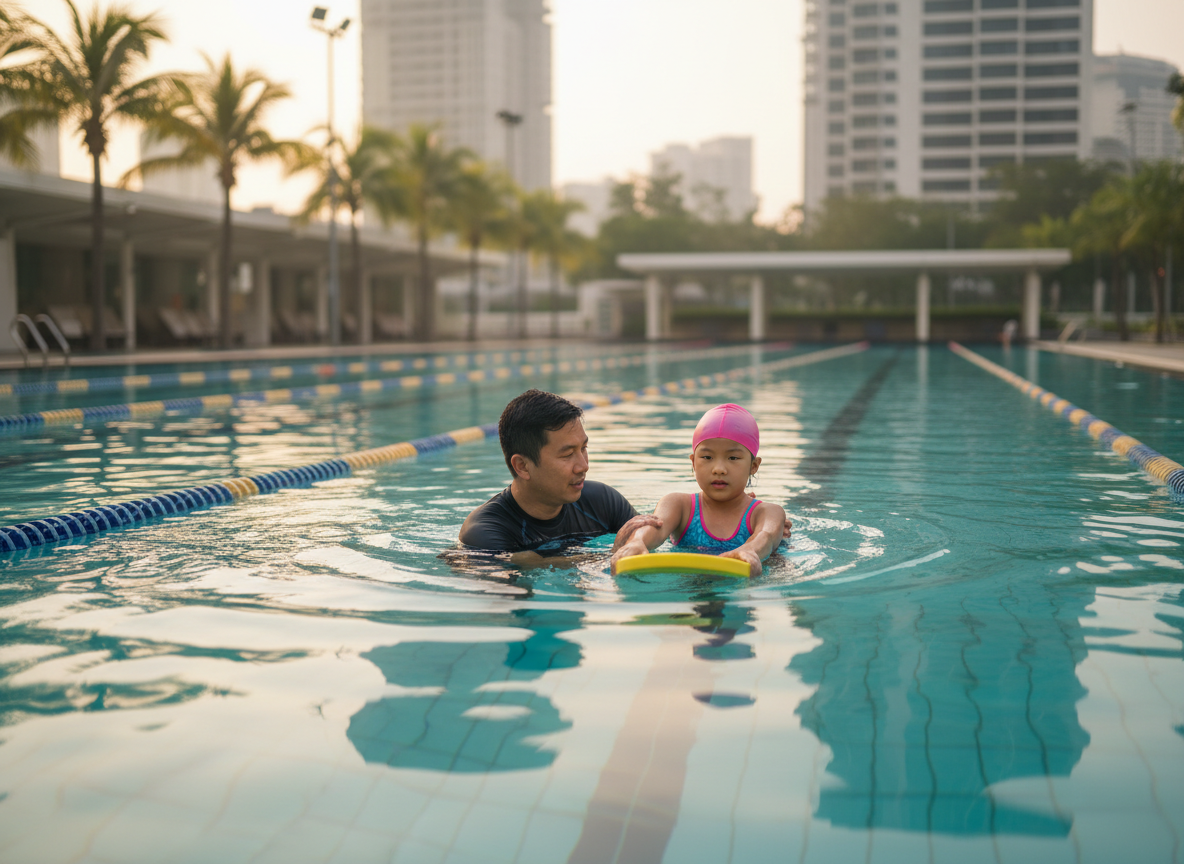
I have taught lessons in a great many private and condominium pools around Singapore. Some are a pleasure to work in. Some are, frankly, badly conceived, and the owners had no idea what to ask when they commissioned them. Here is what I would have told them.
Decide What the Pool Is For, First

| Purpose | Depth that works | Length | Non-negotiable feature |
|---|---|---|---|
| Teaching children to swim | Shallow end where a child stands with shoulders clear | Any | Gentle gradient, no sudden drop |
| Adult lap swimming | Uniform, roughly 1.2–1.5 m | As long as the plot allows | Consistent depth; no shallow section to graze knuckles |
| Aqua exercise | Chest-deep for an adult | Any | Handrails and a broad step |
| Cooling off and entertaining | Whatever you like | Any | Slip-resistant decking |
| Diving | Do not build a diving pool at home | — | Genuinely, do not |
The last row is not a joke. Domestic pools are almost never deep enough for safe diving, and head and spinal injuries from diving into shallow water are catastrophic and permanent. If your pool is under two metres, mark it clearly as no-diving and mean it.
The Things That Determine Whether It Swims Well
Uniform depth beats a graded floor for anyone doing lengths. Swimming from deep to shallow means catching your hand on the bottom on every stroke as you approach the wall.
A wall you can push off. Sloped or beach-entry edges look wonderful and give a lap swimmer nothing to turn against.
Length over width. A pool twelve metres long is worth considerably more to a swimmer than a square pool of the same area.
Water depth at the shallow end, sized to the smallest person using it. A child who can stand with their shoulders out of the water learns quickly. A child on tiptoes learns fear.
Shade. This is Singapore. A pool in full afternoon sun is unusable for half the day, and I have watched lessons abandoned because the water was too warm to be pleasant.
Safety Features to Insist On
- Four-sided isolation fencing with a self-closing, self-latching gate. This is the single most effective drowning prevention measure for home pools. Fencing that uses the house as one side is markedly less effective, because children get out through the house.
- Anti-entrapment drain covers. Suction outlets have trapped and drowned children. Modern compliant covers exist. Ask for them by name.
- Slip-resistant surround. Most pool injuries happen out of the water.
- Clear depth markings and a no-diving marking on any pool under two metres.
- A handrail and broad steps at the entry point. Useful for beginners, older swimmers, and anyone pregnant.
- Rescue equipment stored at the poolside, not in a shed.
Fencing, covers and alarms reduce risk. They do not replace supervision. A child near water needs an adult within arm’s reach, watching, not scrolling. Armbands, rings and noodles are toys and have contributed to drownings by giving parents false confidence.
Vetting a Contractor: Ten Questions

- Are you licensed and insured, and may I see the documents rather than a claim on a website?
- Can I visit two pools you built more than five years ago, and speak to those owners?
- What is the exact depth profile, in a drawing, with numbers?
- What filtration and sanitation system, and what will it cost me to run monthly?
- Which drain covers will you fit, and are they anti-entrapment compliant?
- What are the fencing and barrier requirements for my property, and are they in the quote?
- Who handles the permits and approvals?
- What is the written warranty on the shell, the plant and the finishes, separately?
- What is not in this quote? Ask it exactly that way.
- What is the payment schedule, and what triggers each stage?
Get three quotes. Compare what is excluded, not what is included — that is where quotes diverge. A contractor who will not put the depth profile in writing is telling you something.
Maintenance, Realistically
A pool in Singapore’s climate needs consistent chemical balancing, regular filter attention, and frequent skimming. Algae move fast in this heat. Whether you do it yourself or contract it out, budget the time or the money honestly at the start rather than discovering it in month three.
Water chemistry matters for swimmers, not just for the pool. Badly balanced water stings eyes, irritates skin and, at the extremes, is genuinely unpleasant to train in.
Common Mistakes
- Choosing on price. Structural repairs cost more than the saving.
- Building a beautiful pool nobody can swim a length in. Curved, tapered, sloped — stunning to photograph, useless for lessons.
- Treating fencing as optional or ugly. It is neither.
- Skipping shade. You will regret this by the second month.
- Building a deep end “for diving.” Almost no home pool is deep enough. It creates risk and adds cost.
- Not asking what maintenance costs. Ongoing running costs outlast the build by decades.
- Assuming a home pool means your children will learn to swim. Proximity teaches nothing. Instruction does.
Frequently Asked Questions
How do I find reliable pool companies near me?
Ask for references from pools built five or more years ago, verify licensing and insurance directly, and visit finished work in person. Recent projects always look good. Old ones tell the truth.
What depth should a home pool be?
For general family use with lap swimming, a uniform depth of roughly 1.2 to 1.5 metres works well. Shallower if young children are the main users. Deep ends add cost, add risk, and add little.
Do I need a fence around a private pool?
Requirements vary by property type and jurisdiction, and your contractor should know the rules for your case. Regardless of the legal minimum, four-sided isolation fencing with a self-latching gate is the measure most strongly associated with preventing child drownings.
Can my children learn to swim in our own pool?
A suitable home pool may be convenient for lessons when its depth, access, supervision and safety features match the learner. Owning a pool is not itself a swimming lesson. Enquire about private lessons at your own pool and include its depth profile, location and current access rules.
Is a condominium pool good enough for lessons?
Frequently, yes, and coaches teach in them daily. Depth and gradient are what matter. A pool with a long, uniform stretch is worth more than a large one.
How long does a pool build take?
Long enough that any contractor promising speed should be treated cautiously. Weather, permits and materials all intervene. Ask for a schedule with stages rather than a single date.
Before You Sign
Write down what the pool is for. Show that sentence to every contractor you meet, and ask them how their design serves it. The good ones will have opinions. The rest will show you photographs.
Swimming ability can support safer pool use but never replaces barriers, active supervision or appropriate emergency planning. If household members need instruction, use the contact link above to discuss their current skills and suitable lesson arrangements.

🏊 From the Pool Deck — Our Coaching Experience
Having guided over 5,000 swimmers across Singapore since 2015 — from adults who feared the water to children aiming for SwimSafer Gold — every tip and recommendation in this article comes directly from our coaches’ real-world experience at poolside. We coach weekly at condominiums, public pools, and private facilities islandwide, and we update our content to reflect what we actually see working for Singapore swimmers today.
📚 Official Sources & Further Reading
About This Article
Written by the PrivateSwimming.sg coaching team — AUSTSWIM-certified instructors and Singapore Lifesaving Society (SLSS) members who have personally coached over 5,000 swimmers across Singapore since 2015, from anxious beginners to competitive teenagers preparing for SwimSafer Gold. Our coaches hold current First Aid and CPR certifications and operate under Singapore’s Child Protection (Vulnerable Persons) framework. Our swim curriculum is aligned with Sport Singapore’s SwimSafer 2.0 programme, the Singapore Swimming Association (SSA) coaching standards, and the Health Promotion Board (HPB) active living guidelines.
✔ AUSTSWIM Certified | ✔ SLSS Qualified | ✔ SwimSafer 2.0 Educators | ✔ 5,000+ Swimmers Coached Since 2015 | ✔ Sport Singapore Aligned | ✔ SSA Coaching Standards | Last reviewed: September 2026


Leave a Comment