

Water Ball Shooter Games That Build Water Confidence
Carefully supervised play may help some children participate more comfortably in shallow water, but it does not replace formal skill teaching or guarantee progress. Choose activities around the child’s ability, product instructions and active supervision, and stop if the child is distressed.
Any coach who works with anxious children knows this. The trick is choosing games that quietly demand the skills you want, and never games that reward holding your breath.
Why Games Work

Fear in the water is a breathing problem before it is anything else. A frightened child holds their breath, tenses their shoulders, lifts their chin and stops listening. Nothing you say lands.
Give them a target to aim at and a sibling to beat and the breathing normalises without a single instruction. They duck under to dodge. They blow water off their lips. They put their face in to retrieve something. Every one of those is a skill on the learn-to-swim ladder, and they arrive free.
Games and What They Teach
| Game | Skill it builds | Water depth |
|---|---|---|
| Water ball shooter target practice | Comfort with splashing on the face | Poolside or shallow |
| Balloon retrieval from the bottom | Face in water, eyes open, brief duck | Standing depth, waist-high |
| Bubble blowing race | Controlled exhalation — the core of breathing | Waist-high |
| Push the ball across with your nose | Face in water, horizontal body | Waist-high |
| Star float competition | Floating, relaxation | Chest-high, adult beside |
| Ring collection in a line | Repeated ducks with recovery to standing | Waist to chest-high |
Notice that none of them is a breath-holding contest. That omission is deliberate and it is the most important thing in this article.
Reusable Balloons, Briefly

Reusable magnetic balloons are silicone spheres that seal shut when dipped in water and burst on impact. They replace single-use latex balloons, which shed fragments that end up in drains, in the sea, and occasionally inside animals.
They refill in seconds, which matters more than it sounds — the old game stalled every five minutes while somebody tied knots. And they cost nothing to run.
The magnets are small and strong. Keep the packet away from toddlers, because swallowed magnets are a genuine surgical emergency.
Safety, Which Is the Whole Point
Water games raise noise, excitement and distraction — the exact three conditions under which children drown unnoticed.
- One adult, watching, doing nothing else. Not refereeing. Not filming. Watching. Hand the role over out loud when you swap.
- Non-swimmers stay within arm’s reach. Always, at any depth.
- Drowning is silent. A child in trouble does not shout or splash. In a loud game, they simply disappear.
- No breath-holding games. Ever. Competitions to stay under longest, or to swim a length underwater, can cause shallow-water blackout — a silent, warningless loss of consciousness. It has drowned strong swimmers and it happens in shallow, supervised pools. Stop it every time you see it, and explain why.
- No running on the deck, no jumping in on top of anybody, no shooting at faces at close range.
- Armbands and inflatables are toys. They are not safety devices and they must never substitute for supervision.
- If you are drinking, you are not the watcher.
- Sun, heat and hydration. Children playing in water do not notice they are overheating. Shade breaks, and drinks.
Common Mistakes
- Letting the game drift into breath-holding. It always drifts unless you steer it.
- Playing in water too deep for the shortest child. Depth should be set by the smallest player, not the average.
- Assuming a game replaces lessons. Games build confidence. Lessons build skill. Both.
- Filming instead of watching. The phone has drowned more attention than anything else on a pool deck.
- Making a frightened child play. Confidence is invited, never forced. A child thrown into a game they fear learns to fear the pool.
- Leaving magnets where a toddler can reach. Ingested magnets are a medical emergency.
Turning Confidence Into Swimming
Games get a child comfortable. They do not teach a child to float, recover to standing, or swim to the side — the three skills that actually keep them alive.
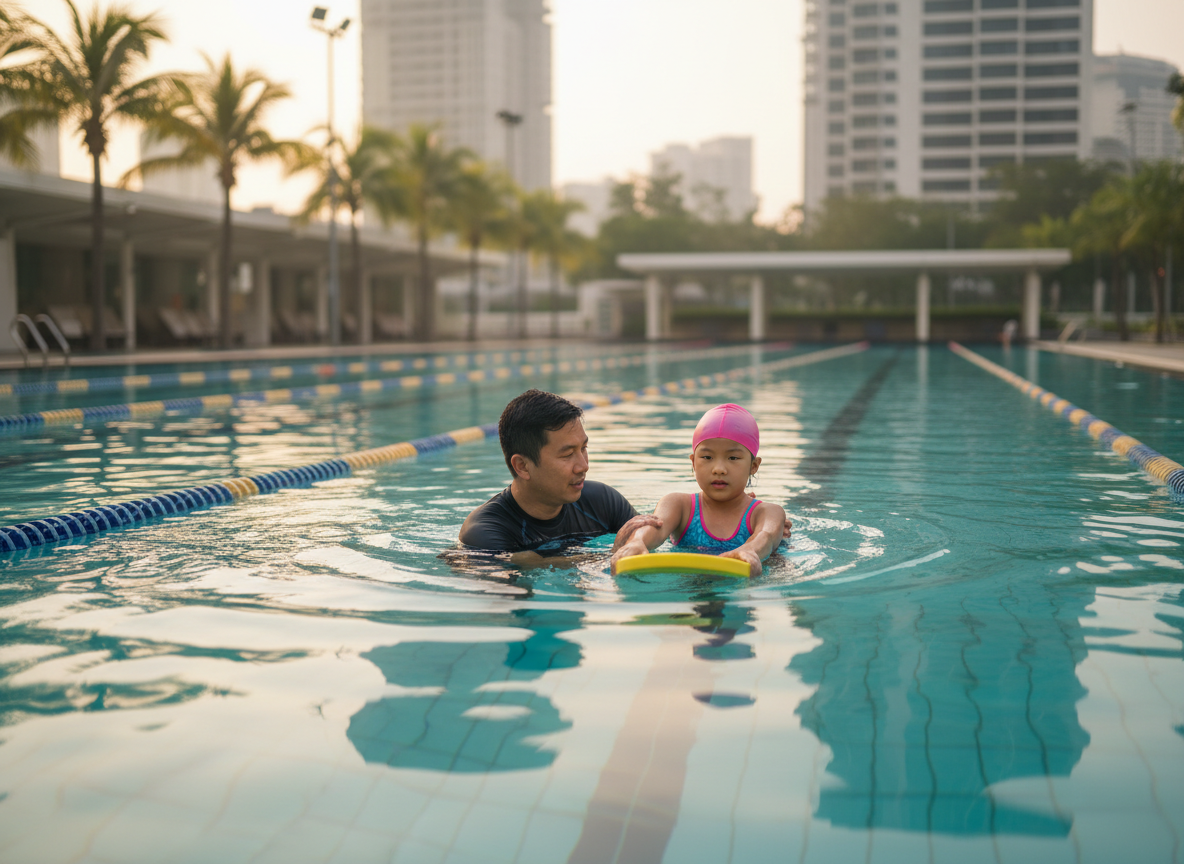
Comfort putting the face in the water can be a useful sign that a child is ready for more structured teaching, but progress is individual. Some children enjoy groups; others may benefit from quieter one-to-one attention. Supervised play between lessons can reinforce familiarity, but it does not guarantee faster progress or replace active supervision and formal skill teaching. Enquire about private swimming lessons if you would like to discuss your child’s comfort, current skills and preferred setting.
For public pool programmes and water safety guidance, ActiveSG is the place to start.
Frequently Asked Questions
What age is a water ball shooter suitable for?
Do not use age alone to decide. Follow the product manufacturer’s current age, parts and supervision instructions, consider the individual child, and keep magnetic components away from any child who may mouth or swallow them. Never aim at anyone’s face.
Can water games really teach swimming?
They teach the prerequisites: relaxed breathing, face-in-water comfort, and a willingness to be splashed. Strokes, floating and self-rescue need proper teaching.
Are reusable balloons better than latex ones?
They may reduce loose latex fragments when used and maintained correctly, but the overall environmental impact depends on materials, durability and disposal. Inspect them for damage, account for every component and follow the manufacturer’s instructions.
Why are breath-holding games dangerous?
Repeated or prolonged breath-holding, particularly after hyperventilating, can cause shallow-water blackout: consciousness is lost without warning and without struggle. It has killed strong swimmers in shallow, lifeguarded pools.
How do I stop a game becoming chaotic?
Set the depth by the smallest child, agree three rules out loud before starting, and keep one adult watching rather than playing.
My child hates getting splashed. What now?
Start at the poolside rather than in the water, with the child holding the shooter rather than being the target. Control is the antidote to fear.

🏊 From the Pool Deck — Our Coaching Experience
Having guided over 5,000 swimmers across Singapore since 2015 — from adults who feared the water to children aiming for SwimSafer Gold — every tip and recommendation in this article comes directly from our coaches’ real-world experience at poolside. We coach weekly at condominiums, public pools, and private facilities islandwide, and we update our content to reflect what we actually see working for Singapore swimmers today.
📚 Official Sources & Further Reading
About This Article
Written by the PrivateSwimming.sg coaching team — AUSTSWIM-certified instructors and Singapore Lifesaving Society (SLSS) members who have personally coached over 5,000 swimmers across Singapore since 2015, from anxious beginners to competitive teenagers preparing for SwimSafer Gold. Our coaches hold current First Aid and CPR certifications and operate under Singapore’s Child Protection (Vulnerable Persons) framework. Our swim curriculum is aligned with Sport Singapore’s SwimSafer 2.0 programme, the Singapore Swimming Association (SSA) coaching standards, and the Health Promotion Board (HPB) active living guidelines.
✔ AUSTSWIM Certified | ✔ SLSS Qualified | ✔ SwimSafer 2.0 Educators | ✔ 5,000+ Swimmers Coached Since 2015 | ✔ Sport Singapore Aligned | ✔ SSA Coaching Standards | Last reviewed: September 2026


Leave a Comment