

Swimming Exercise Routine for When Two Lengths Wreck You
If you can swim but arrive at the far wall gasping, pacing, breathing, body position and current conditioning can all contribute. A useful swimming exercise routine starts with short, comfortable intervals and generous rest, then increases distance only when you can keep your breathing and technique controlled. Repeatedly swimming to exhaustion can reinforce rushed technique.
This is the single most common thing I hear from adults. They run 5 km without much trouble and cannot manage 50 metres of freestyle. Land fitness does not automatically translate into efficient swimming. Moving through water while coordinating each breath is a specific skill, and your starting fitness still affects how much work and recovery are appropriate.
Why You Are Out of Breath
Three causes, in order of how often I see them.
You start too fast. Almost everyone does. The first fifteen metres feel effortless, so you swim them at a pace you cannot hold, and you are in oxygen debt before the flags.
Your hips are low. Dragging legs turn a swim into a tow. You are working three times as hard for the same speed, and no amount of aerobic base will cover that.
You are not exhaling. Nervous swimmers hold their breath under water, then try to breathe out and in during one turn of the head. There is not time. Exhale steadily into the water, and the inhale takes care of itself.
A Progressive Swimming Exercise Routine
Use the stages below as examples rather than a calendar. Choose a frequency you can recover from, rest until your breathing feels controlled, and repeat or shorten a stage whenever technique breaks down.
| Stage | Main set | Rest | Focus |
|---|---|---|---|
| Foundation | Up to 10 × 25 m easy | 30–45 s, or until breathing is normal | Exhale under water, eyes down |
| Short repeats | Up to 8 × 50 m easy | 30 s | Same pace on both lengths |
| Longer repeats | Up to 6 × 75 m, or 4 × 100 m | 20–30 s | Count strokes; keep the count steady |
| Endurance | Build toward longer repeats or a continuous easy swim | 30 s between repeats | Even pacing start to finish |
Every session:
- Warm-up. 100–200 m very easy, any stroke, no clock.
- Kick. 4 × 25 m on your side, lower arm extended, eyes on the pool floor. This trains the position that stops your legs sinking.
- Breathing drill. 4 × 25 m humming out through the nose the whole time your face is down. Silence means you are holding your breath.
- Main set. Choose the table stage you can complete with controlled breathing and repeatable technique.
- Cool-down. 100 m easy backstroke or breaststroke.
If a stage feels hard, shorten or repeat it. Controlled breathing and repeatable technique matter more than the calendar or the distance.
Making It Sustainable

Swimming is a low-impact sport, which is why it suits people who cannot run and people carrying joint problems. That same quality makes it easy to do consistently for decades. Consistency, not intensity, is what makes a swimming exercise routine work.
Eat normally around your sessions and drink water — you dehydrate in a pool without noticing. For individual dietary or weight advice, speak to a doctor or a registered dietitian rather than a fitness article.
Take at least one full rest day between hard sessions. Adaptation happens while you are not swimming.
Common Mistakes
- Swimming until you cannot. Stop the set when your technique falls apart, not when your arms do.
- Cutting the rest. Short rest looks impressive and produces sloppy, breathless swimming.
- Only ever swimming freestyle. Backstroke is a gift for shoulder balance and for learning to relax while breathing freely.
- Chasing distance. A tidy 400 m beats a desperate 1,000 m every time.
- Doing hypoxic sets to “build lung capacity”. Restricted-breathing and breath-hold training risks shallow-water blackout — sudden unconsciousness with no warning — and has killed fit swimmers. It is unnecessary and you should never attempt it alone.
- Ignoring shoulder pain. Reduce volume and see a physiotherapist. Swimming through shoulder pain turns a niggle into a season off.
Safety

Swim where there is a lifeguard, or with a competent person watching. Most condominium pools have no lifeguard — treat them as unguarded water.
Never swim alone if you are pushing intervals. Fatigue and deep water are a poor combination, and the swimmer who gets into trouble is rarely the one who expected to.
No alcohol before swimming, ever. And if you have a heart condition, are pregnant, or are returning from surgery or injury, get medical clearance before starting a new routine.
Frequently Asked Questions
How many times a week should I swim?
Two to three sessions builds skill and fitness without wrecking your shoulders. More is only useful once your technique holds up when you are tired.
Why can I run 5 km but not swim 50 metres?
Because swimming is a skill sport wearing a fitness sport’s clothes. Poor body position and panicked breathing consume oxygen faster than your legs ever did.
Should I use a kickboard?
Sparingly. Kicking flat on a board encourages a lifted head. Side kicking with one arm extended teaches something more useful.
How long until I can swim continuously?
Most adults who follow an interval progression with honest rest reach continuous swimming within four to eight weeks. Rushing it extends the timeline.
Is swimming enough exercise on its own?
It is excellent cardiovascular and muscular work with no joint impact. It does little for bone loading, so pair it with some weight-bearing activity.
Do I need a coach for this?
Not for the fitness. Almost certainly for the body position — you cannot see your own hips, and the fault always feels normal from the inside.
Where to Get Help
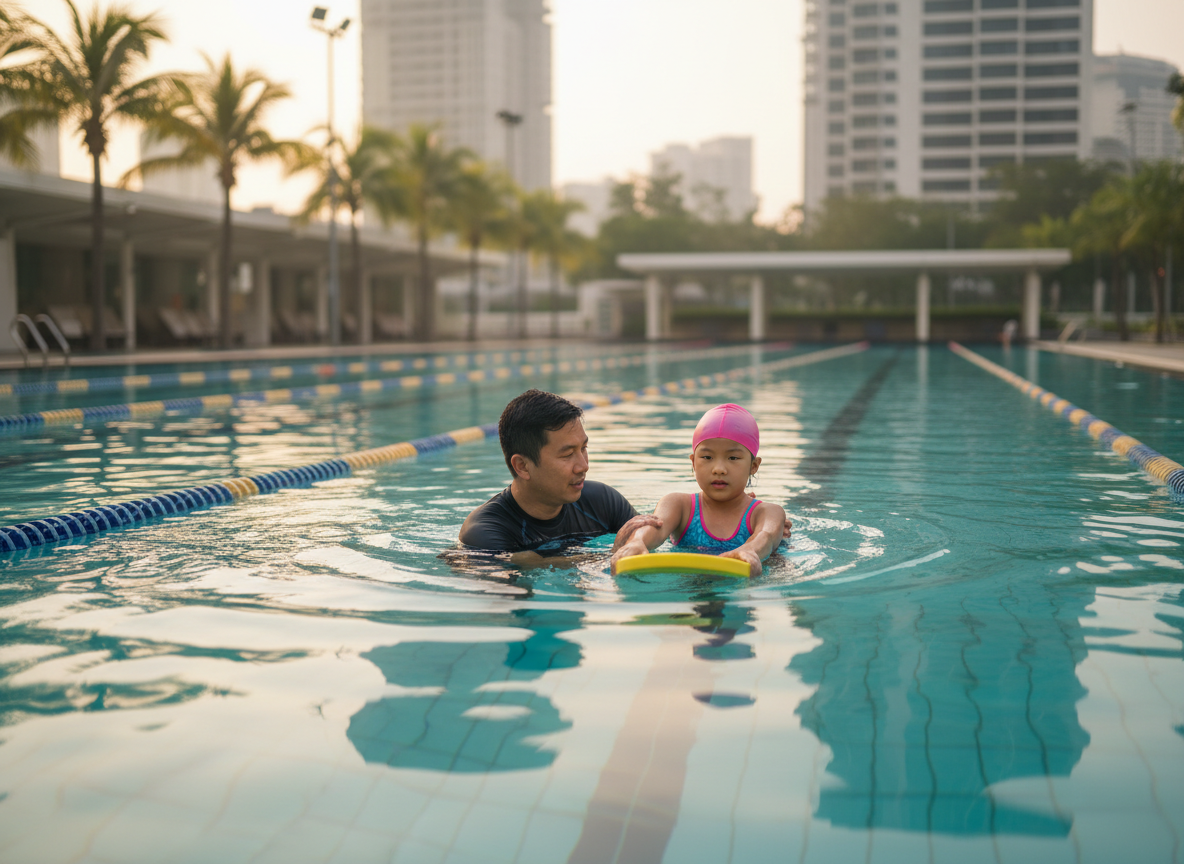
If breathing is what stops you, a handful of one-to-one lessons will resolve it faster than months of solo lengths. Adults starting from very little water confidence should begin with structured beginner lessons, and swimmers who want to train in their own building can arrange condo pool coaching. For stroke refinement once you can hold a length, see a swim coach.
Pool schedules and public programmes are listed on ActiveSG.

🏊 From the Pool Deck — Our Coaching Experience
Having guided over 5,000 swimmers across Singapore since 2015 — from adults who feared the water to children aiming for SwimSafer Gold — every tip and recommendation in this article comes directly from our coaches’ real-world experience at poolside. We coach weekly at condominiums, public pools, and private facilities islandwide, and we update our content to reflect what we actually see working for Singapore swimmers today.
📚 Official Sources & Further Reading
About This Article
Written by the PrivateSwimming.sg coaching team — AUSTSWIM-certified instructors and Singapore Lifesaving Society (SLSS) members who have personally coached over 5,000 swimmers across Singapore since 2015, from anxious beginners to competitive teenagers preparing for SwimSafer Gold. Our coaches hold current First Aid and CPR certifications and operate under Singapore’s Child Protection (Vulnerable Persons) framework. Our swim curriculum is aligned with Sport Singapore’s SwimSafer 2.0 programme, the Singapore Swimming Association (SSA) coaching standards, and the Health Promotion Board (HPB) active living guidelines.
✔ AUSTSWIM Certified | ✔ SLSS Qualified | ✔ SwimSafer 2.0 Educators | ✔ 5,000+ Swimmers Coached Since 2015 | ✔ Sport Singapore Aligned | ✔ SSA Coaching Standards | Last reviewed: September 2026


Leave a Comment